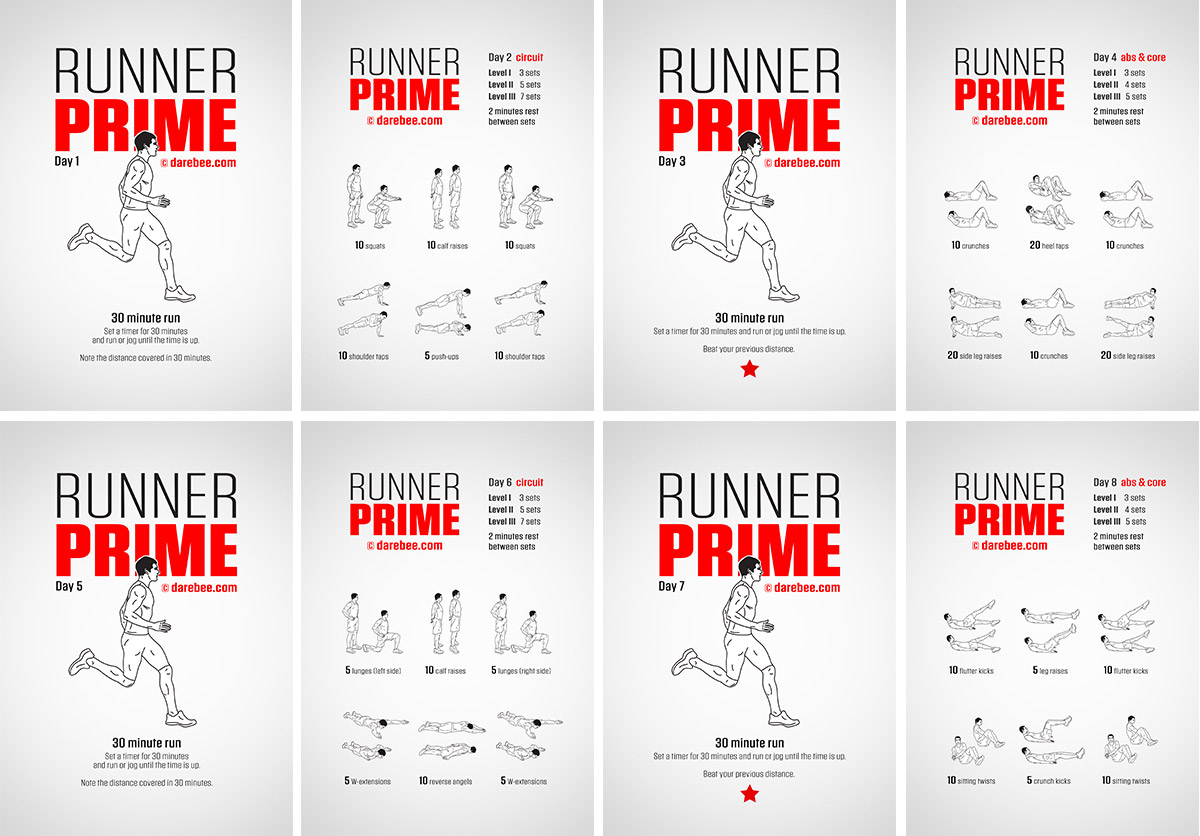
Runner Prime is a 31-day program that puts running at its heart and builds the body around it. Every other day you set a timer for 30 minutes and run or jog until it stops, at whatever pace and on whatever route you like; the days in between are short bodyweight circuits, alternating between full-body work and abs and core. No equipment, no set distances, no mileage tables - just the clock, your legs, and a number you write down.
The rhythm is simple enough to learn in a week and then stops needing thought. Run, train, run, train. Half the runs ask you only to note the distance you covered; the other half, marked with a red star, ask you to beat it. That is the entire progression: the 30 minutes never grow, and the only thing that changes is how much ground you fit inside them. The circuits between the runs take care of the rest - calves, hips, glutes, core, the muscles that carry a stride and the ones that keep it straight - in sessions short enough to sit comfortably next to a run.
By the end you have 16 recorded runs, and a first number and a last number that tell you exactly what a month did. You will run more evenly, judge your own pace without looking at a watch, and know what a slightly better run feels like from the inside. The program runs on a clean alternation, so it can be repeated straight away with the last distance as the new starting mark, or taken as a base into any running goal you have next. Day 1 is a timer and a run. Start there.

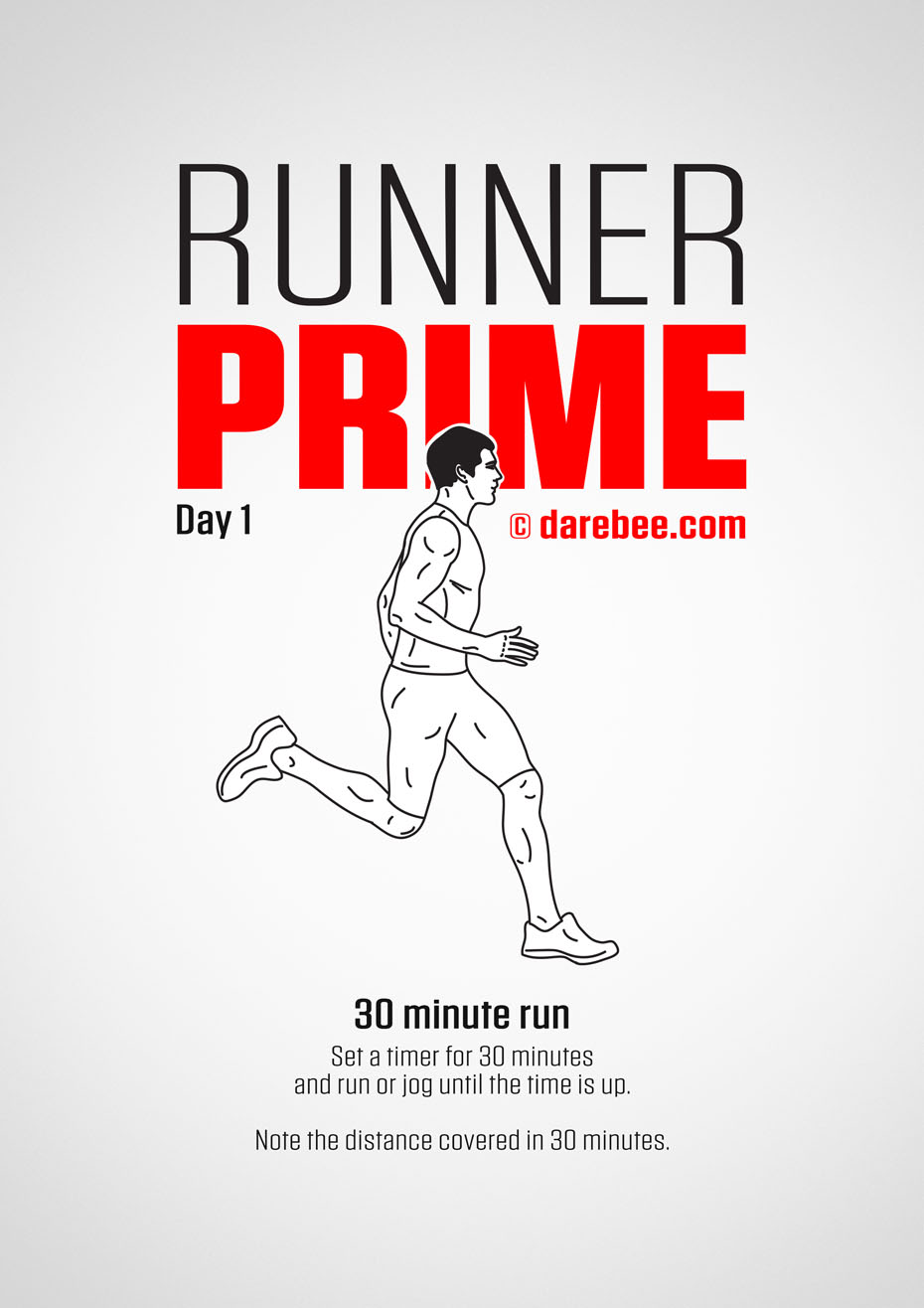
Runner Prime starts the way it means to go on: with a run. Set a timer for 30 minutes and run or jog until it stops. Pace is entirely yours today, and so is the route - road, park, track, treadmill, all of it counts. The only instruction that carries weight is the last line on the card: when the timer goes off, note how far you got.
That number is the whole point of the day. Runner Prime never asks you to run a set distance; it asks for 30 minutes, every other day, and it uses the distance you cover inside them as the measure of your progress. Today's figure is your starting point, so there is no target to hit and nothing to beat. Run at a pace you could hold a conversation at, let the first ten minutes be slower than you think they should be, and treat the last ten as a chance to find out what a settled rhythm feels like.
Measure the distance any way you can trust: a running app, a watch, or a loop whose length you already know. Write the number down somewhere you will see it again, because in two days the card will ask you to beat it. Land softly, keep your shoulders loose and your arms swinging low, and if you need to walk for a stretch, walk and then pick the run back up - the timer keeps counting either way.
Thirty minutes, one number, and the program has its first line in the book.
Make it Harder: Run the final five minutes at a pace that is clearly quicker than the first twenty-five, and note whether it changes your distance.
Make it Easier: Alternate two minutes of jogging with one minute of walking for the full 30 and record the distance exactly the same way.

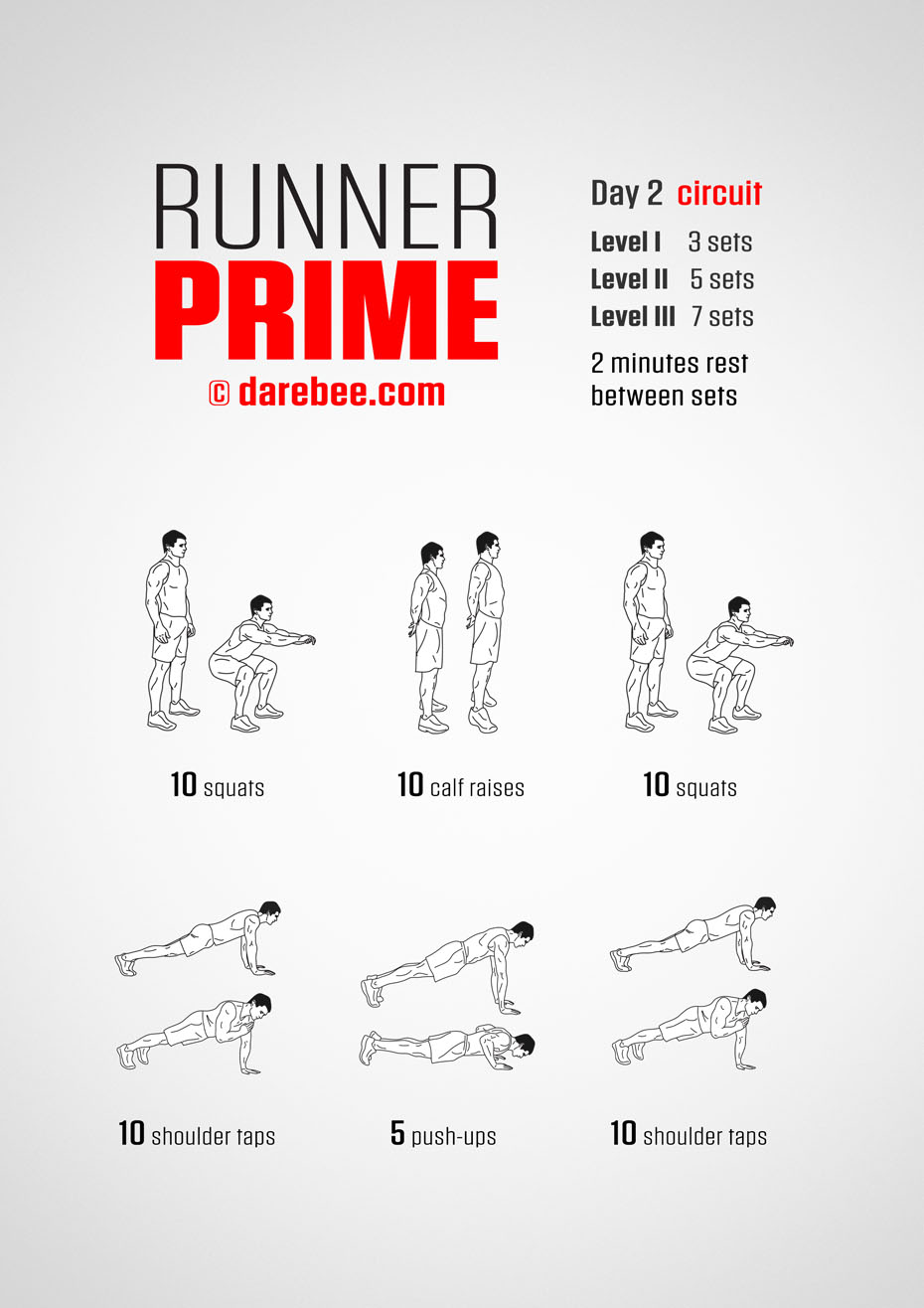
Day 2 is the first circuit, and it introduces the format every training day in Runner Prime uses. Six exercises sit on the card: 10 squats, 10 calf raises, 10 squats, 10 shoulder taps, 5 push-ups and 10 shoulder taps. Work through all six in order without stopping - that is one set - then rest for 2 minutes and go again. How many sets you do is the level you pick: Level I is 3 sets, Level II is 5, Level III is 7. Choose the level you can finish with good form today; you can move up on the next circuit day.
The card is built as two sandwiches. The squats bookend the calf raises, so your legs get 20 squats per set with the calves working in the middle, and the shoulder taps bookend the push-ups, so your upper body gets 20 taps around 5 presses. Squats and calf raises are the runner's basics: hips, thighs and calves doing the loading and landing you ask of them on every stride. The shoulder taps are done in a full plank - hands under shoulders, body straight from head to heels - lifting one hand to touch the opposite shoulder, then the other, 10 touches in all. That keeps your trunk braced while your weight shifts, which is the job it has on the run, too.
Squat to at least thigh-parallel with your heels down and your chest up, and stand all the way tall at the top. On calf raises, rise onto the balls of your feet as high as you can and lower with control rather than letting your heels fall. In the shoulder taps, keep your hips square and still; the tap is the easy part, not rocking is the exercise. Push-ups go chest to just above the floor with elbows tucked at roughly 45 degrees - five clean ones beat five rushed ones.
Yesterday you ran; today you build the body that runs.
Make it Harder: Bring your feet together in plank for the shoulder taps so every touch has to be balanced on a narrow base.
Make it Easier: Take the push-ups to your knees and widen your feet in plank for the shoulder taps.

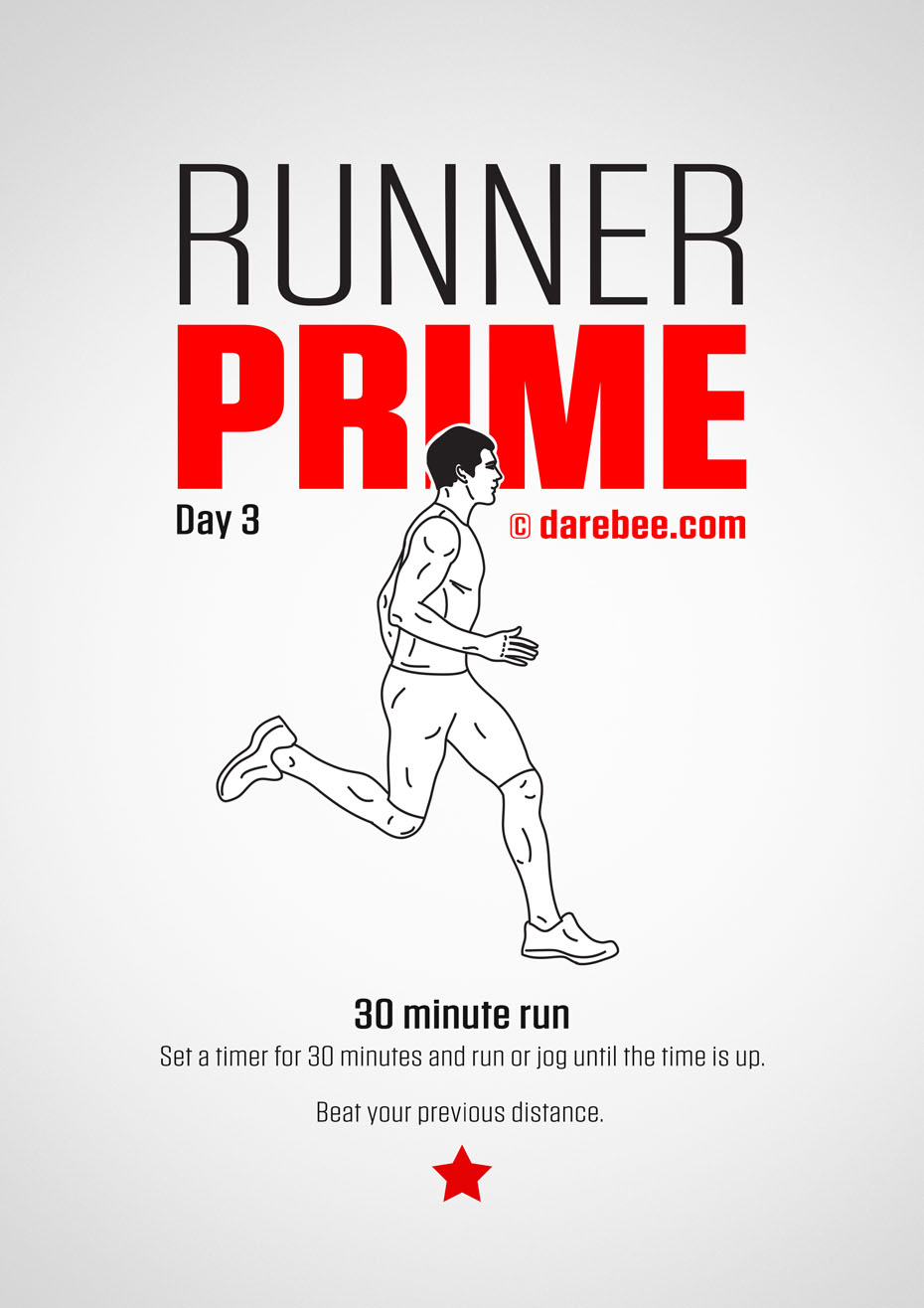
Day 3 is the first red star. Same timer, same 30 minutes, same run or jog until it ends - but the last line on the card has changed. Instead of noting your distance, you are asked to beat it: cover more ground than you did on Day 1 in the same amount of time. This is the second half of the pairing Runner Prime is built on. A plain run sets the number, the star run chases it, and the two alternate all the way to Day 31.
Beating a distance does not mean sprinting from the start. The margin can be small: 50, 100 or 200 metres more than last time is a win, and it is the kind of win that stacks. The cleanest way to find it is to run the first half exactly as you did on Day 1 and then hold your pace a little more firmly in the second half, where most runs quietly slow down. Fifty metres over 30 minutes is a few seconds per kilometre. That is the size of the change you are looking for.
Use the same measuring method as Day 1 so you are comparing like with like. Warm into the run with a few easy minutes, keep your steps short and quick rather than long and reaching, and breathe in a rhythm you can keep. If you check your progress mid-run, do it once, not every minute. When the timer stops, look at the number, compare it with two days ago and write today's down as well - the next star day, Day 7, will chase whatever you post on Day 5.
The star is not asking for a great run, only a slightly better one.
Make it Harder: Aim for the top of the range and go 200 metres past Day 1's distance rather than 50.
Make it Easier: Match Day 1's distance exactly - equalling it under the star still counts as holding the line.

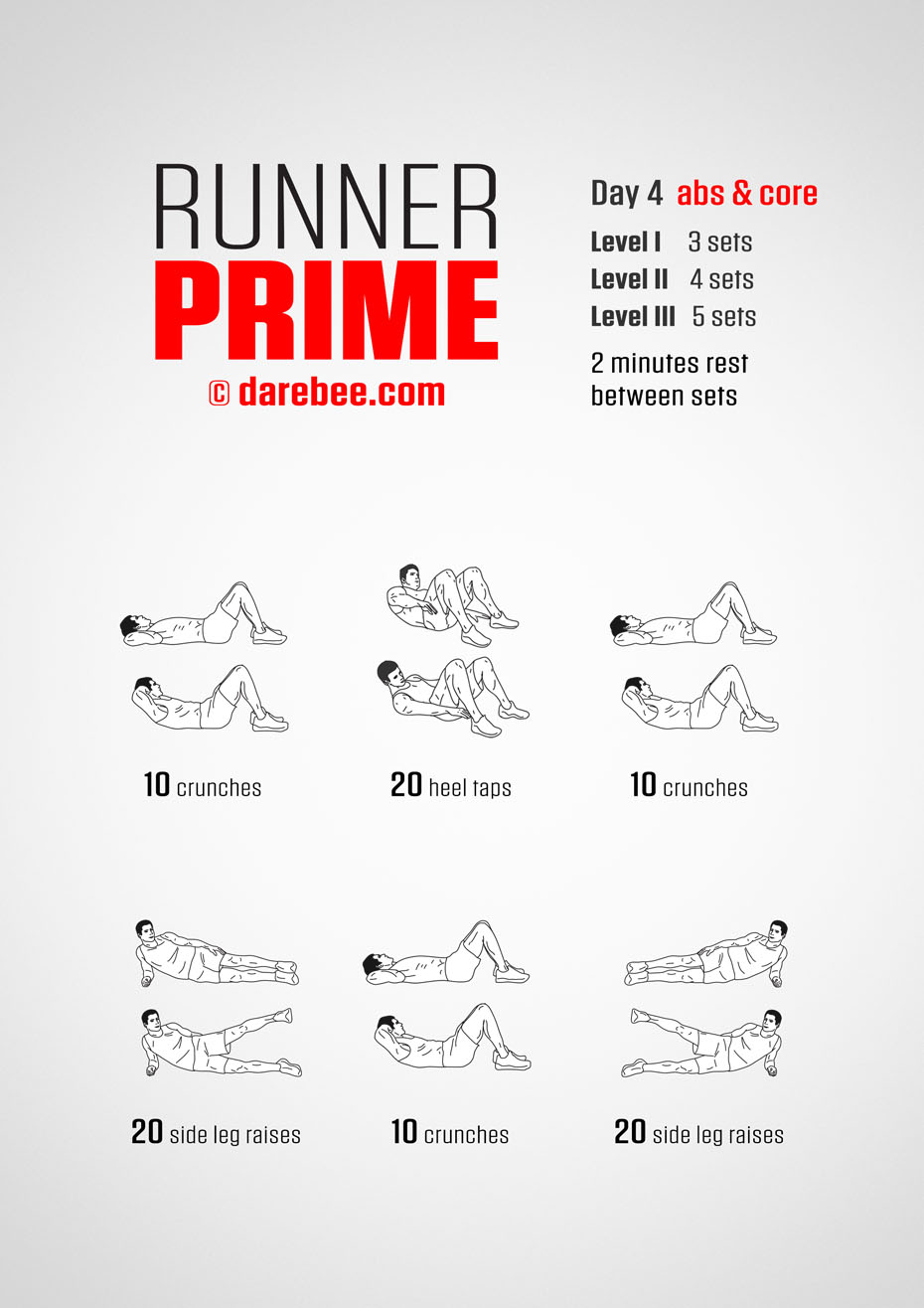
Day 4 opens the second kind of training day. Abs & core days run on the same circuit rule as Day 2 - all six exercises in order is one set, 2 minutes rest between sets - but with their own level ladder: Level I is 3 sets, Level II is 4, Level III is 5. Everything on this card happens lying down: 10 crunches, 20 heel taps, 10 crunches, 20 side leg raises, 10 crunches and 20 side leg raises again. Crunches turn up three times, so each set carries 30 of them.
The card alternates between the front of the trunk and its sides. Crunches curl the shoulders off the floor with the knees bent and feet flat, working the abs directly. Heel taps keep the shoulders lifted and reach one hand toward the same-side heel, then the other, 20 touches in all, which pulls the obliques into the job. The side leg raises are the lying version: on your side, propped on your forearm, lifting the top leg straight up and lowering it with control. The two side leg raise pictures are mirrored for a reason - do the first 20 on one side and the last 20 on the other, so both hips get the full count. These are the muscles that keep your pelvis level with every stride, which is why they get equal billing with the abs on a runner's program.
On crunches, lift with the abs rather than pulling on your neck; the movement is small and the top of it should feel like a squeeze. Keep your lower back on the floor through the heel taps and let the reach come from the side of your waist. For the side leg raises, stack your hips, keep the toes pointing forward rather than up, and lift the leg from the hip without letting your torso tip backward.
Runners are built from the middle out, and this is where the middle starts.
Make it Harder: Lift your feet off the floor for the crunches so your knees stay bent above your hips for the whole set.
Make it Easier: Cut the heel taps and side leg raises to 10 each and keep the crunches as written.

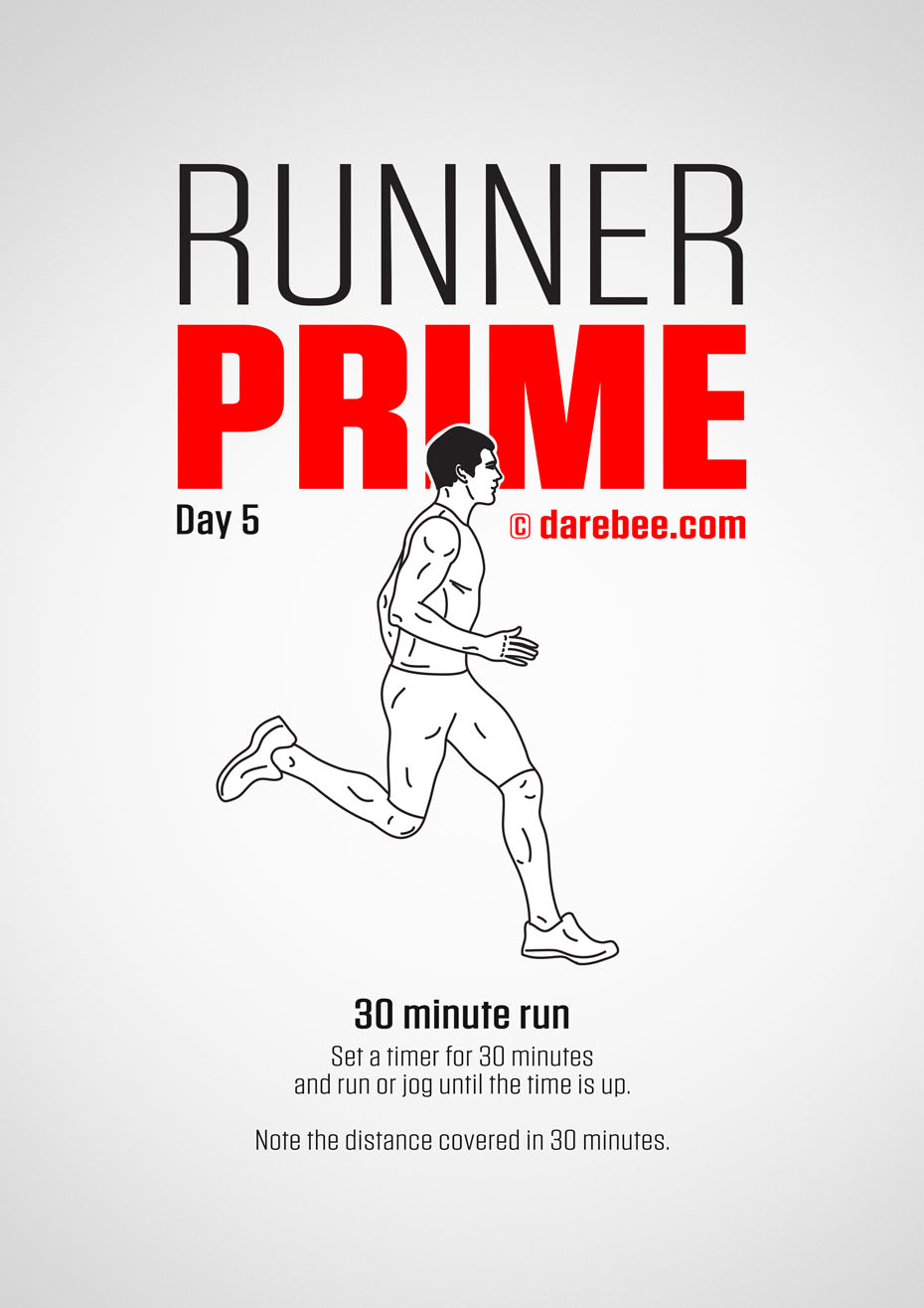
Day 5 resets the count. It is a plain 30-minute run: timer on, run or jog until it ends, note the distance. There is no star and no number to beat, which makes this the most relaxed kind of run in the program - the only job is to record whatever you cover. What you post today becomes the target for Day 7.
There is a quiet strategy hidden in these note-the-distance days. Because each star day chases the run before it, an easy baseline sets up an easy win two days later, and a heroic baseline sets up a hard one. Neither is wrong. The program leaves that decision to you every four days, so pay attention to how your legs feel after yesterday's floor work and choose a run that fits: steady if you feel fresh, gentle if you do not.
Focus on rhythm today rather than speed. Count your steps for 30 seconds early on and see if you can keep the same cadence in the last five minutes, when fatigue makes strides longer and slower. Land under your body, keep your hands relaxed, and let your breathing settle into a pattern. Record the distance the same way you did on Day 1 and Day 3.
No star, no pressure, just a number that tells the truth about where you are today.
Make it Harder: Hold a cadence of 170 steps per minute or more for the entire 30 minutes, checking it every five.
Make it Easier: Keep to your very easiest jogging pace throughout - it still sets the baseline and the timer still runs out.

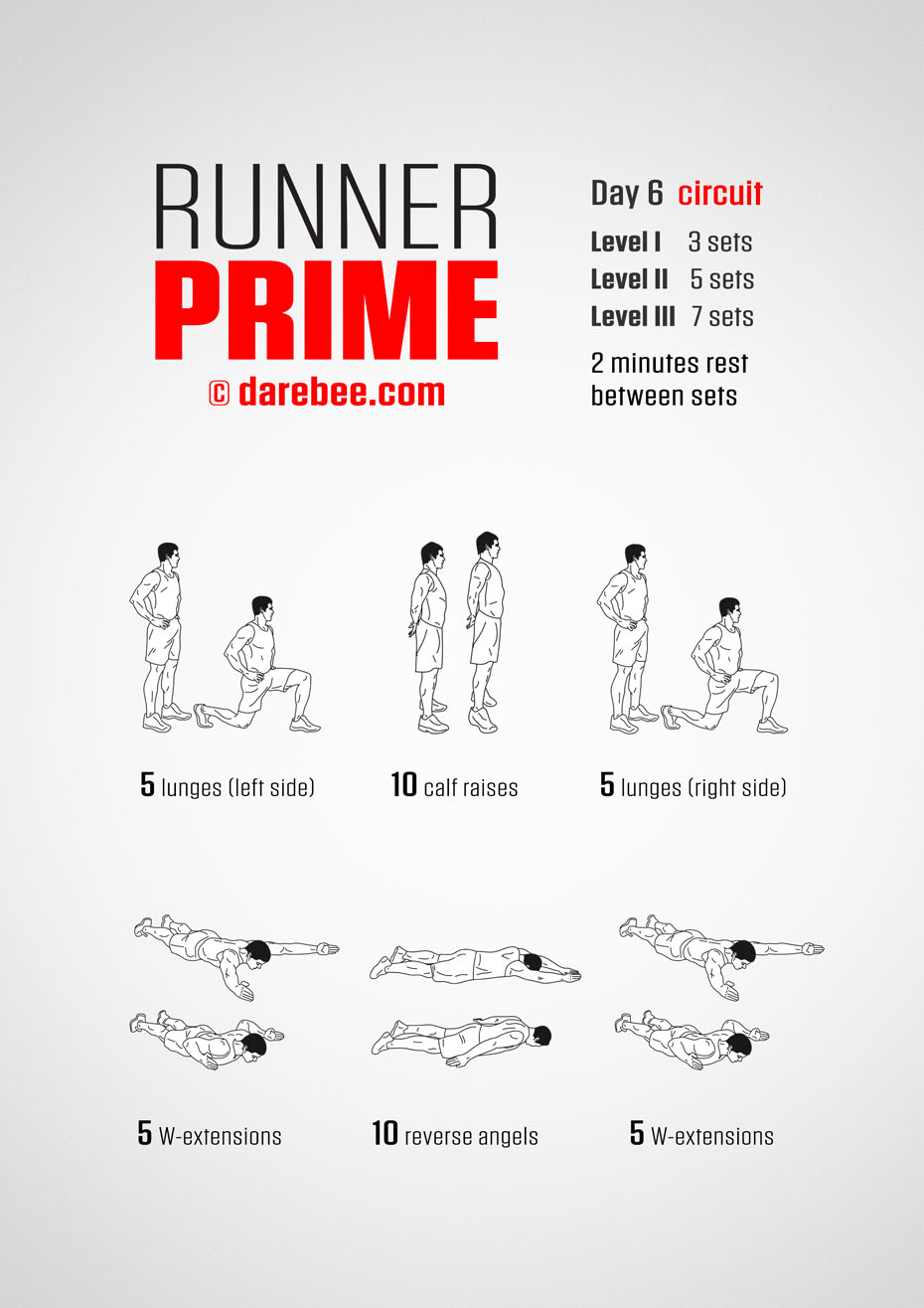
Day 6 is a circuit again, 3, 5 or 7 sets by level with 2 minutes rest, and it splits its attention between your legs and the back of your shoulders. The top row is 5 lunges on the left, 10 calf raises and 5 lunges on the right. The bottom row moves to the floor face down: 5 W-extensions, 10 reverse angels and 5 W-extensions. The lunge count is one of the few on the program that is stated per side, so it really is 5 with the left leg leading and then 5 with the right.
The lunges are forward lunges, hands on hips, stepping out and lowering the back knee toward the floor before pushing back to standing. Running is single-leg work, and the lunge is the closest thing to a stride done slowly enough to feel. The calf raises between the two sides keep the lower legs in the conversation on every circuit day. The floor row is all posture: in W-extensions you lie on your front with your arms bent into a W, lift your chest slightly and extend the arms out straight ahead before pulling them back; in reverse angels the arms sweep straight from your hips to overhead and back, hovering off the floor the whole way. Both wake up the muscles between your shoulder blades that keep your arms swinging freely when you run.
Lunge with a long enough step that your front shin stays roughly vertical, and keep your torso upright rather than leaning forward. On calf raises, pause a moment at the top. For the prone work, keep your gaze at the floor, lift the arms from the shoulder blades rather than by arching your lower back, and keep your hands off the floor between reps so the rear shoulders never switch off.
Legs in front, shoulders behind - the parts that carry a run and the parts that steer it.
Make it Harder: Add a 5-count hold at full extension on the last reverse angel of every set, arms straight and hovering.
Make it Easier: Shorten the lunge step and cut the reverse angels to 6 per set.

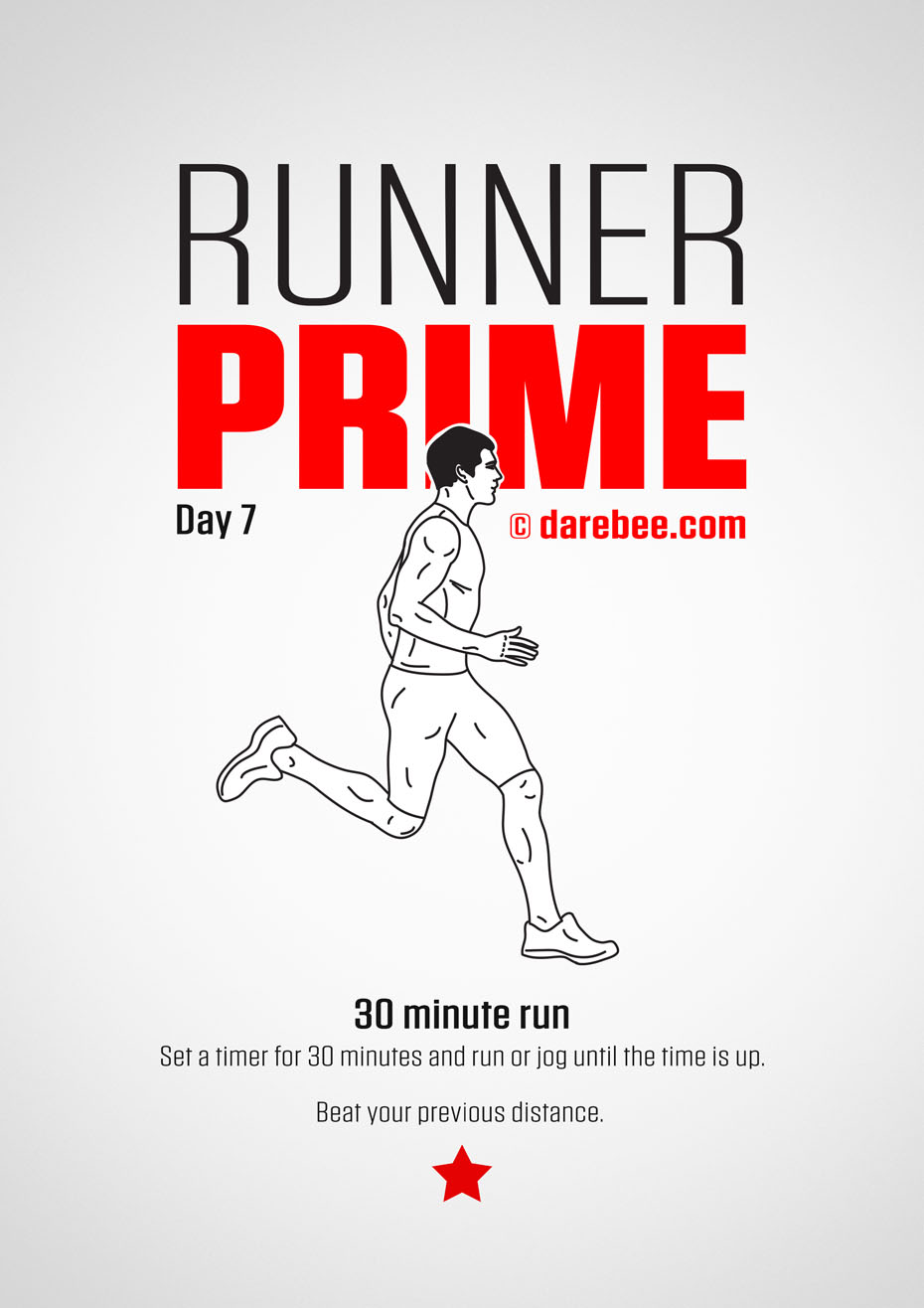
Day 7 carries the red star, so the target is Day 5's distance. Thirty minutes on the timer, run or jog until it ends, and cover more ground than you did last time. If you kept Day 5 gentle, the extra metres should come easily; if you pushed it, this is where you find out what a small improvement actually costs.
One week in, the pattern is fully visible: run, train, run, train, with the runs alternating between setting a mark and beating it. Runner Prime never lengthens the run. The 30 minutes are fixed for all 16 of them, and the distance inside them is the only thing that moves. That is a different kind of progression from adding time or miles - it asks you to run the same box a little faster, a little smoother, a little more evenly each time the star appears.
Try negative splitting today: run the first 15 minutes at your usual pace and the second 15 fractionally faster. Most of the distance you can add lives in the second half, where tired runners drift. Keep your cadence up rather than your stride long, relax your jaw and shoulders, and use the last two minutes to press just enough to know you did. Record the result; Day 9 sets the next mark.
A week done, and the run is already learning how to hunt its own numbers.
Make it Harder: Add a 30-second surge every five minutes and still finish ahead of Day 5's distance.
Make it Easier: Chase the smallest possible margin - 50 metres past Day 5 - and treat anything beyond it as a bonus.

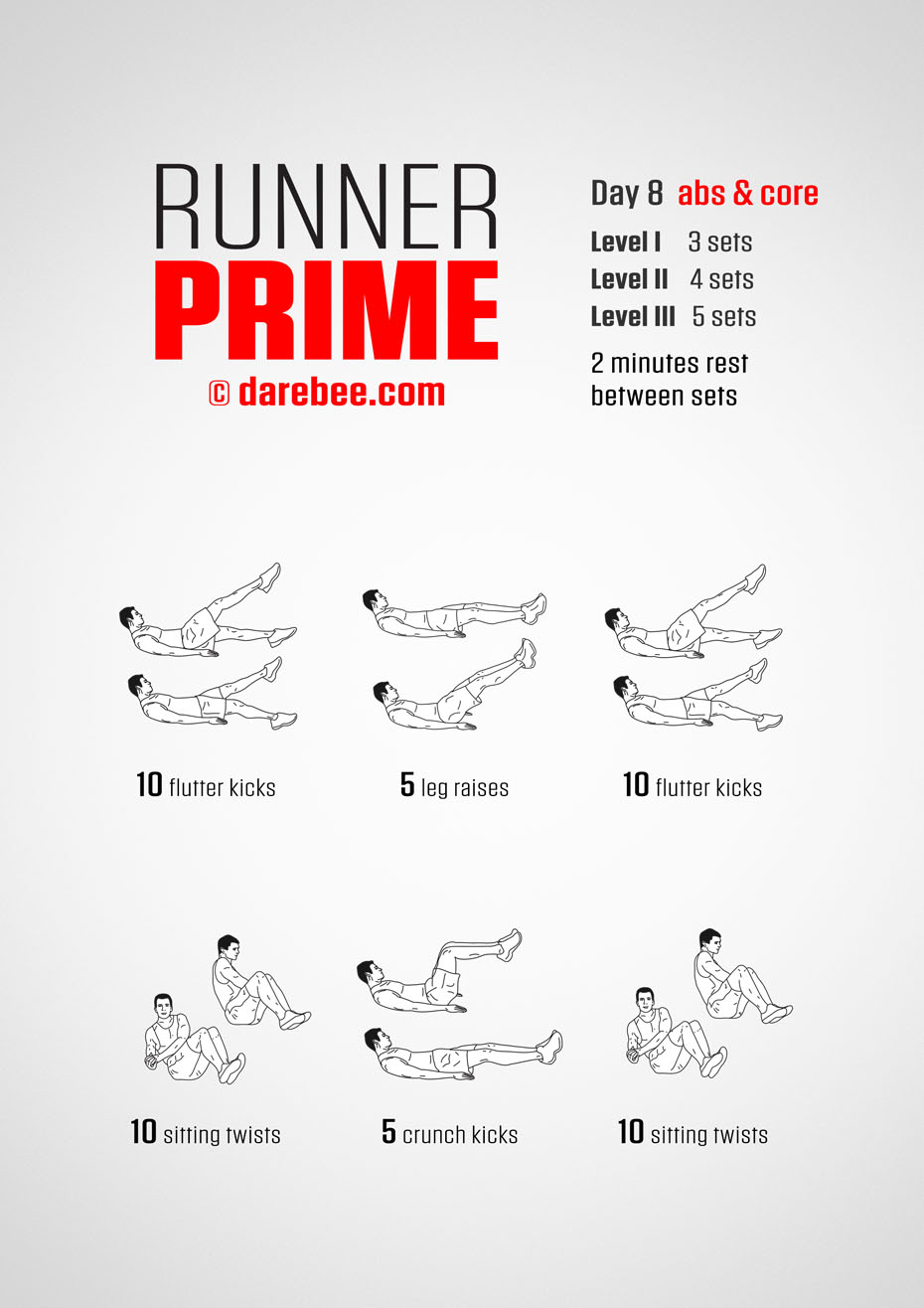
Day 8 keeps your legs in the air. It is an abs & core circuit, 3, 4 or 5 sets by level with 2 minutes rest, and the six exercises are 10 flutter kicks, 5 leg raises, 10 flutter kicks, 10 sitting twists, 5 crunch kicks and 10 sitting twists. Nothing here is a crunch; every exercise loads the abs through the legs or the twist of the trunk instead.
The top row is all lower-abs work from your back. Flutter kicks are small alternating kicks with both legs held just off the floor, 10 kicks in all; leg raises lift both straight legs together toward the ceiling and lower them slowly without letting them touch down. The bottom row changes the angle. Sitting twists are done seated with your feet off the floor and knees bent, turning your shoulders from side to side, 10 turns total. Crunch kicks sit between them: lying back, pull your knees in toward your chest, then kick both legs straight out and hold them just above the floor before the next rep. Five of those is more than it sounds.
Keep your lower back pressed into the floor for every kick and raise; if it lifts, shorten the range and lower the legs less far. In sitting twists, lean back far enough that your abs are working before you even turn, and rotate the ribcage rather than just waving your arms. On crunch kicks, make the kick-out slow and the pull-in tight, and breathe out as the legs extend.
Every exercise here keeps your feet off the floor, and the abs pay for every second of it.
Make it Harder: Straighten your legs for the sitting twists so they stay extended and hovering throughout the set.
Make it Easier: Bend your knees to 90 degrees for the leg raises and crunch kicks, and keep your heels on the floor for the sitting twists.

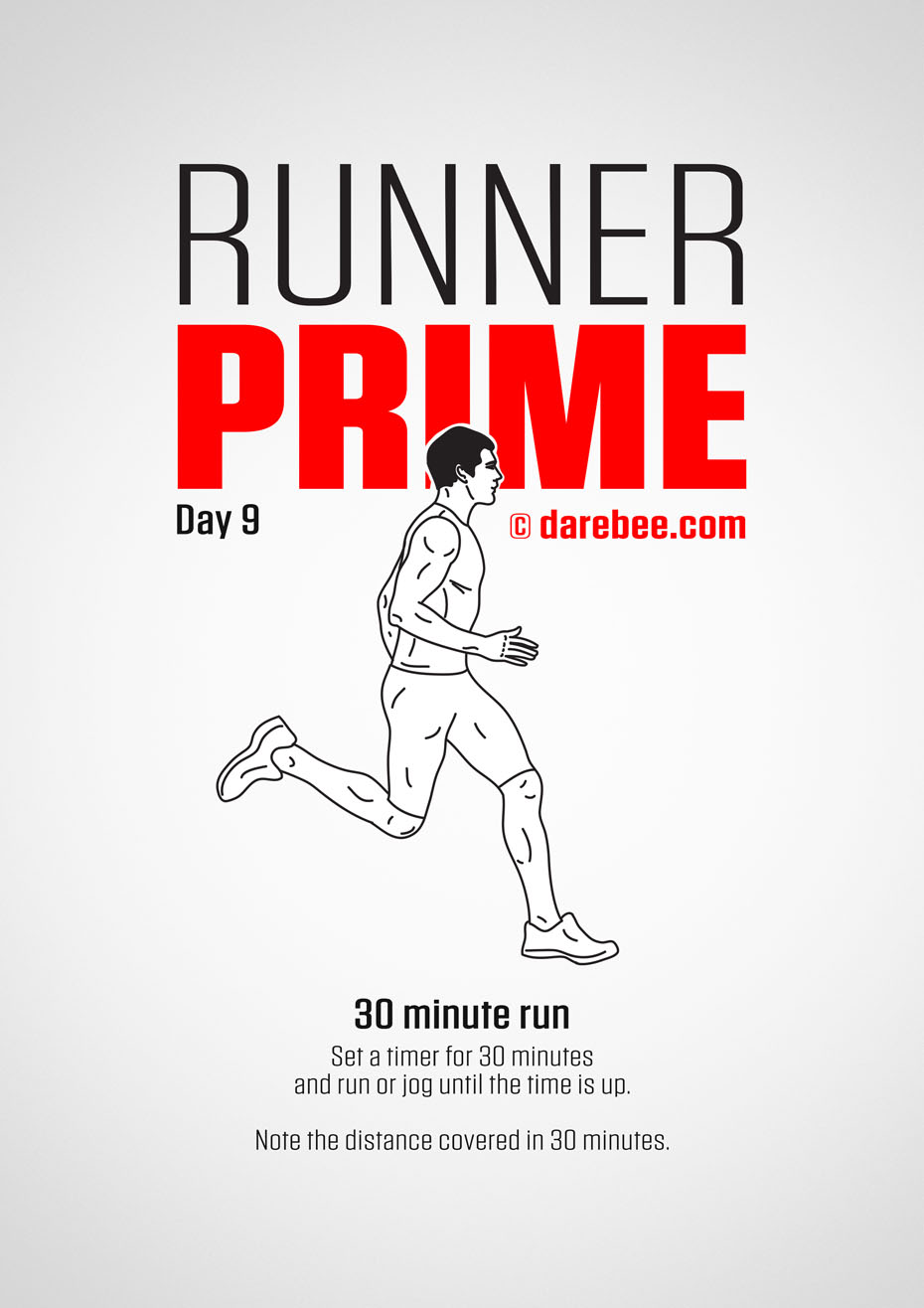
Day 9 is a note-the-distance run: 30 minutes, run or jog, write down what you cover. No star, no target. The distance you record today is the mark for Day 11.
This is a good day to think about terrain. Runner Prime does not care where you run, only that the timer runs out, so a note day is the safest place to change the route: a loop with a hill, a softer trail, a track if you want a completely honest measurement. Variety spreads the load across different muscles and takes some of the pounding off the ones that always work. Just measure consistently, because your Day 11 self will be comparing against whatever you post.
Ease in for the first few minutes, settle your breathing, and pick a pace you could hold for 40 minutes rather than 30. Keep your elbows bent and your arms driving back rather than across your body. Record the distance when the timer sounds, and note the route alongside it - a number is more useful when you know what produced it.
A different road, the same clock, and a fresh number to build the next star on.
Make it Harder: Choose the hilliest route you have and run it without walking any of the climbs.
Make it Easier: Run the flattest, most familiar loop you know and keep the effort conversational from start to finish.

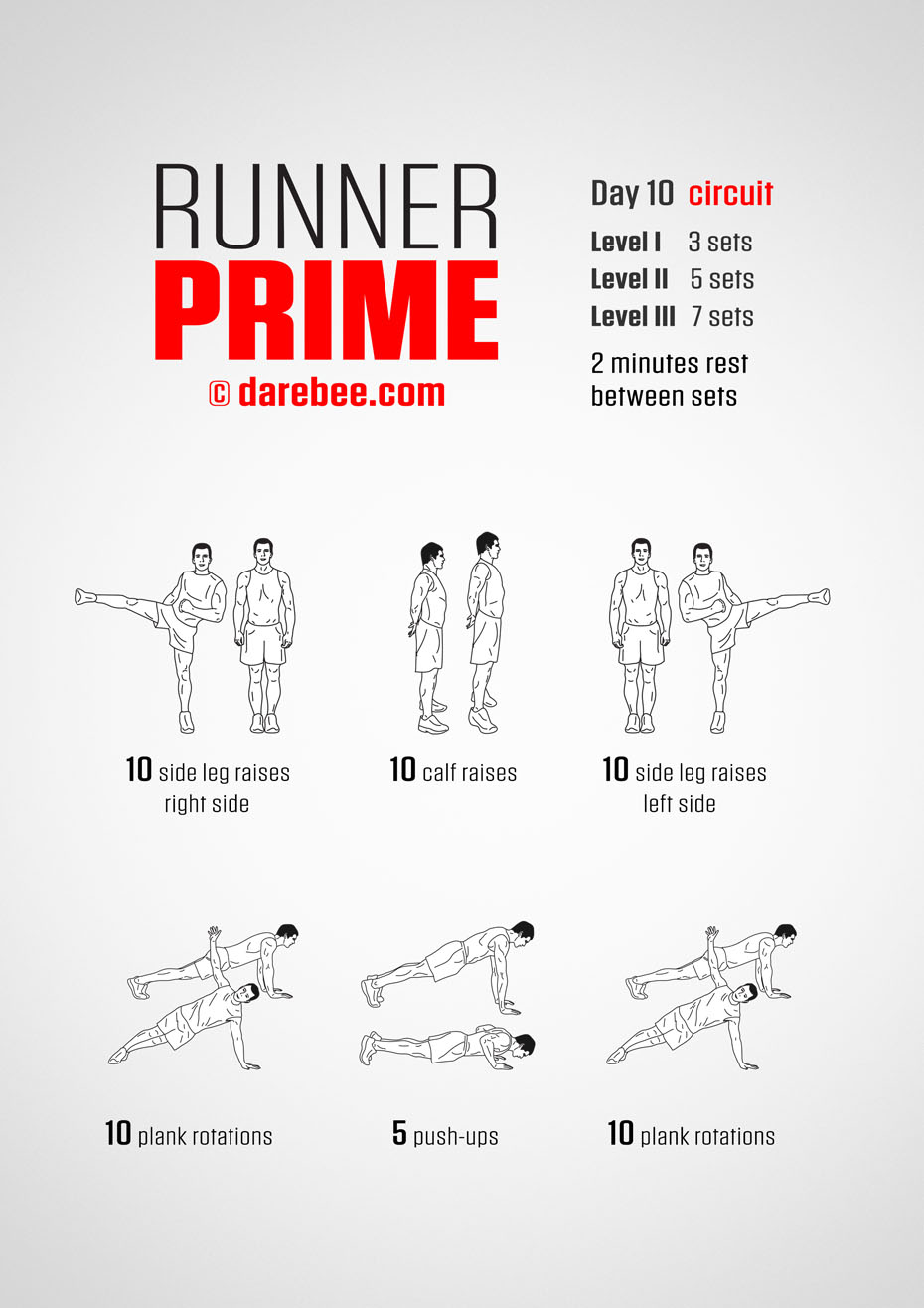
Day 10 is a circuit - 3, 5 or 7 sets, 2 minutes rest - and it trains the sideways stability runners rarely think about. The top row is 10 standing side leg raises on the right, 10 calf raises, 10 standing side leg raises on the left. The bottom row is 10 plank rotations, 5 push-ups and 10 plank rotations. Side leg raises are stated per side on this card, so both hips get a full 10.
The standing side leg raise lifts one straight leg out to the side while the other leg holds you upright, which trains both hips at once: one lifting, one stabilising. The calf raises in the middle give the standing leg a break between sides. Plank rotations start in a full plank on your hands, then rotate the whole body to one side so one arm reaches straight up toward the ceiling into a side plank, return to plank, and rotate the other way - 10 rotations total, alternating sides. The push-ups sandwiched between them keep the shoulders under load while the trunk resets. Everything on the bottom row is about holding a straight line while your weight moves.
Stay tall on the side leg raises: lift the leg only as high as you can without leaning away from it, and keep the toes pointing forward. Calf raises full range, as always. In plank rotations, move as one piece - hips, shoulders and feet turn together - and stack your feet or keep them staggered, whichever lets the hips stay high. Push-ups chest to just above the floor, body straight.
Sideways stability is the part of running nobody sees until it is missing.
Make it Harder: Stack your feet for every plank rotation so each side plank balances on the edge of one foot.
Make it Easier: Touch a wall lightly for balance while the leg lifts sideways, and do the plank rotations from your knees.

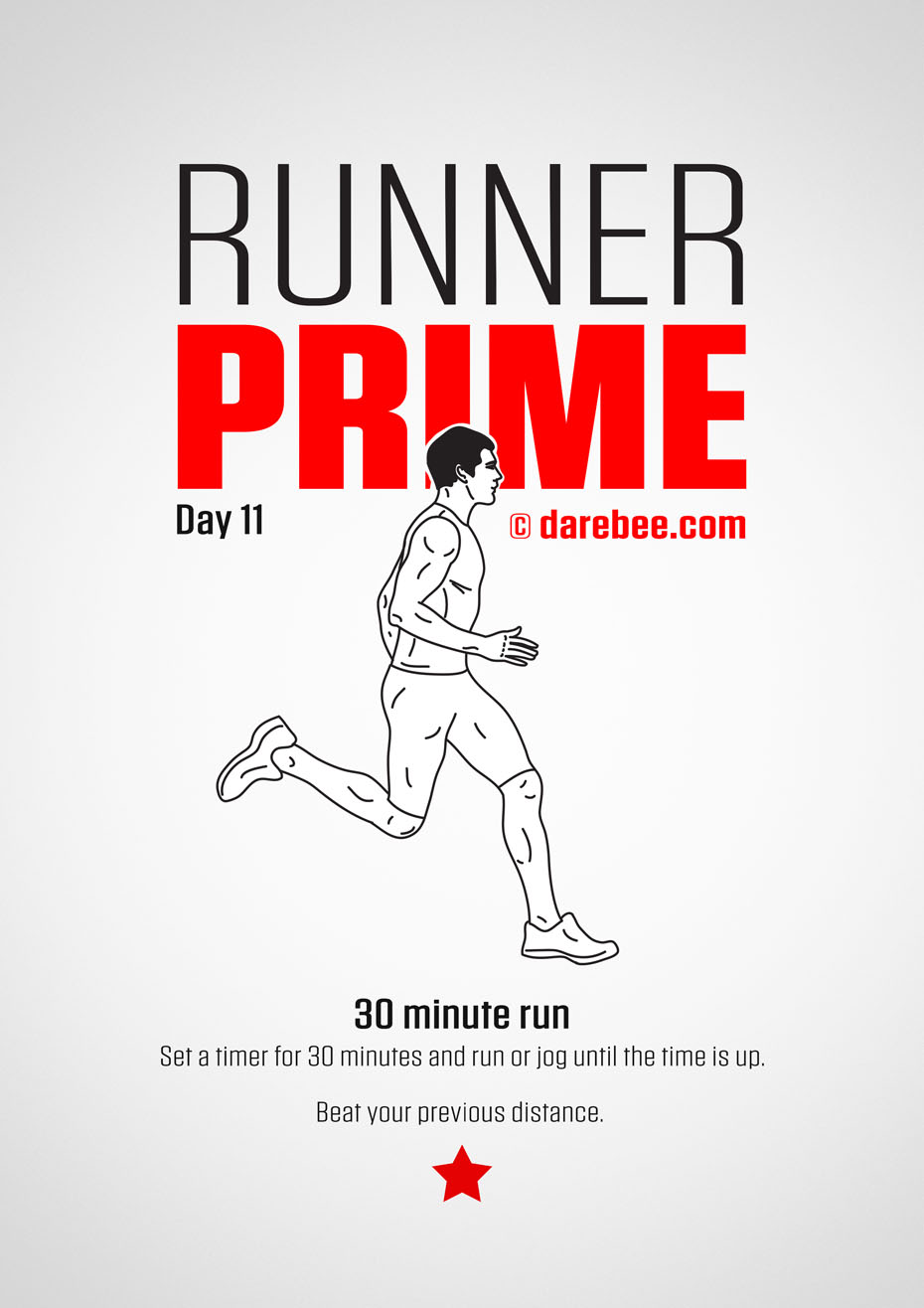
Day 11 is a red star run: 30 minutes, run or jog, beat the distance you noted on Day 9. If you changed the route on Day 9, run the same one today so the comparison holds. The star only means something when the two runs are measured the same way.
Ten days in, you have five recorded runs and two comparisons behind you, and the shape of your running is starting to show in the numbers. Look at them before you head out. If Day 7 beat Day 5 comfortably, your baselines are easy and there is room to push; if it was a scrape, hold the effort steady and let form do the work. The star days are the program's way of teaching pace judgement - not by telling you what pace to run, but by asking you to run slightly better than yourself and letting you work out how.
Try holding your effort perfectly level for the whole 30 minutes rather than speeding up at the end. An even run is often longer than a run with a fast finish, because the middle third does not sag. Breathe in a steady count, keep your hands soft, and let your feet land quietly. When the timer stops, compare, record, and let the number be what it is.
Even pace, even breathing, and a number that quietly moves forward.
Make it Harder: Run the middle ten minutes at a pace that makes talking impossible, then settle and still finish ahead.
Make it Easier: Split the run into three ten-minute blocks in your head and only ask the last block to make up the extra metres.

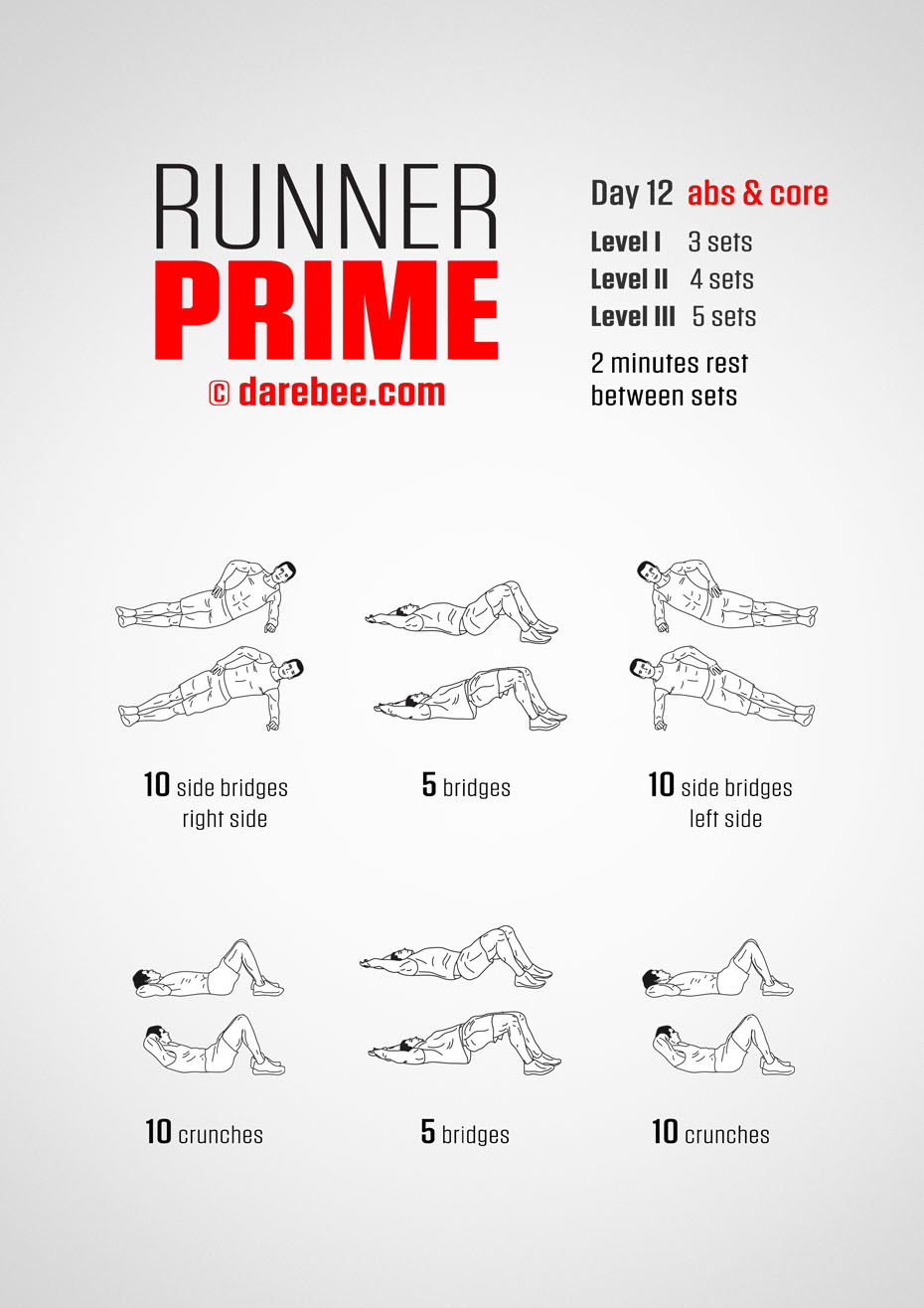
Day 12 is an abs & core circuit, 3, 4 or 5 sets by level, 2 minutes rest, and it brings in the hips. The top row is 10 side bridges on the right, 5 bridges, 10 side bridges on the left. The bottom row is 10 crunches, 5 bridges, 10 crunches. Bridges appear twice, so each set carries 10 of them, and the side bridges are stated per side on the card.
A side bridge is a moving side plank: lying on your side propped on your forearm, knees straight and feet stacked, you lift your hips off the floor until your body is a straight line, then lower them under control and lift again. It works the obliques and the outer hip together, the muscles that stop your pelvis dropping every time you land on one foot. Bridges are the glute exercise between them: on your back, knees bent, feet flat, driving the hips up until your body is straight from knees to shoulders, squeezing at the top and lowering. Crunches finish the card with the front of the abs, the same movement you learned on Day 4.
In side bridges, keep your elbow directly under your shoulder and push the floor away with your forearm so the shoulder does not collapse; the hips travel up and down, the rest of you stays in line. In bridges, drive through your heels and finish with your glutes rather than arching your lower back. Crunches stay small and controlled, chin off your chest, elbows wide.
Hips that lift from the side and from the back - the two directions a runner's pelvis has to be able to resist.
Make it Harder: Do the bridges on one leg, switching the working leg with every set.
Make it Easier: Bend your knees for the side bridges so the pivot point moves from your feet to your knees.

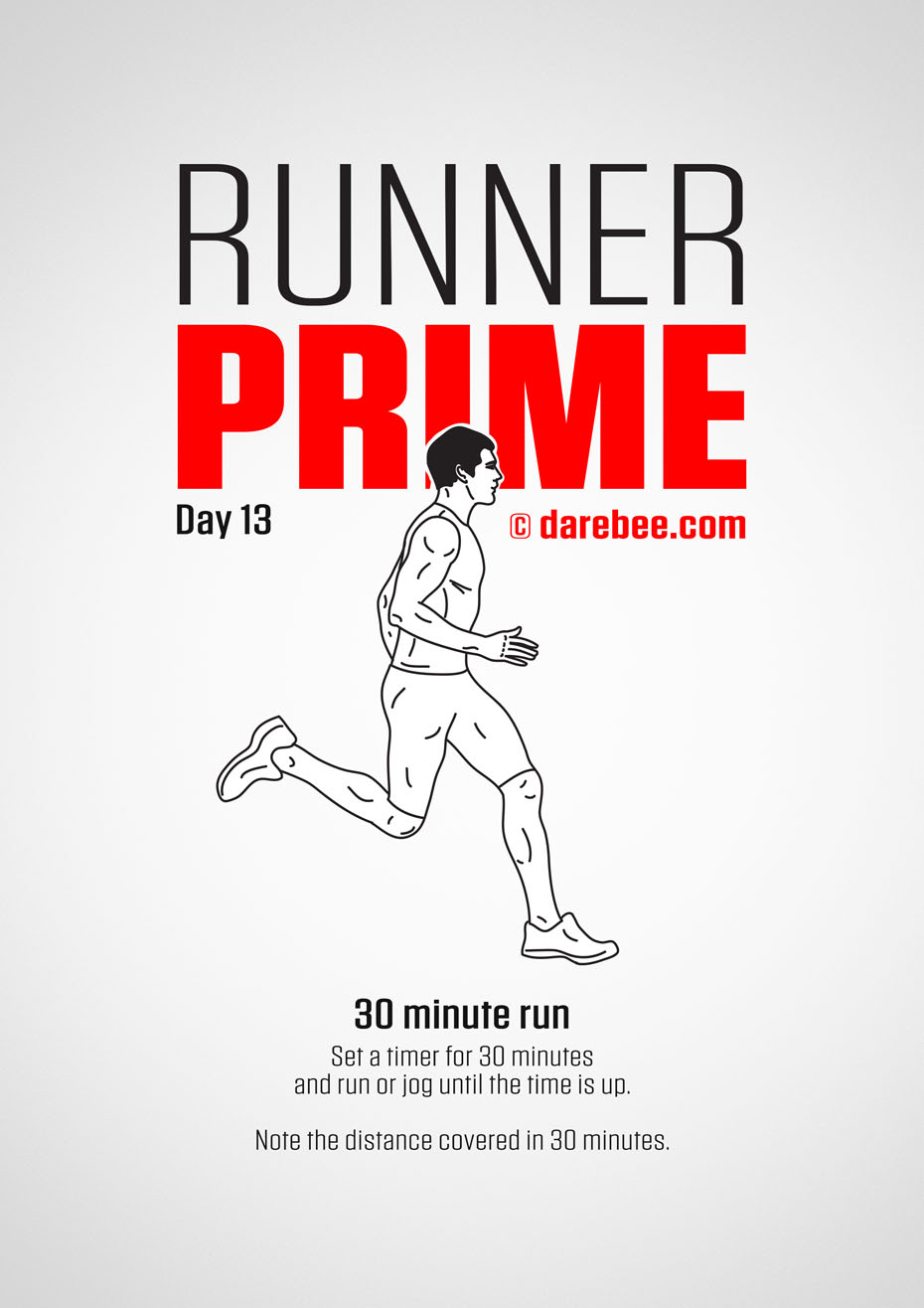
Day 13 is a note-the-distance run. Thirty minutes, run or jog, record how far. Today's number becomes Day 15's target.
Halfway through the program's runs is a good moment to look at the whole list. You should now have six distances written down, three plain and three starred. Notice which kind of run you find easier - the free one or the chased one - because that tells you something about how you respond to a target. Some runners go further when nothing is expected; some only find the extra when the star is there. Either way, use today accordingly: a relaxed run if the numbers suggest you have been pressing, a firm one if they suggest you have room.
Work on your arms today. Bent to about 90 degrees, driving back from the shoulder, hands loosely closed, no crossing in front of your chest - the arms set the rhythm the legs follow, and tired arms creep up toward the ears and shorten the stride. Check them every five minutes. Record the distance when the timer stops.
Six numbers in the book and a run that finally has a history to read.
Make it Harder: Run this one as a progression: each ten-minute block slightly faster than the one before.
Make it Easier: Jog it at the pace you would use to warm up for something else and record whatever that produces.

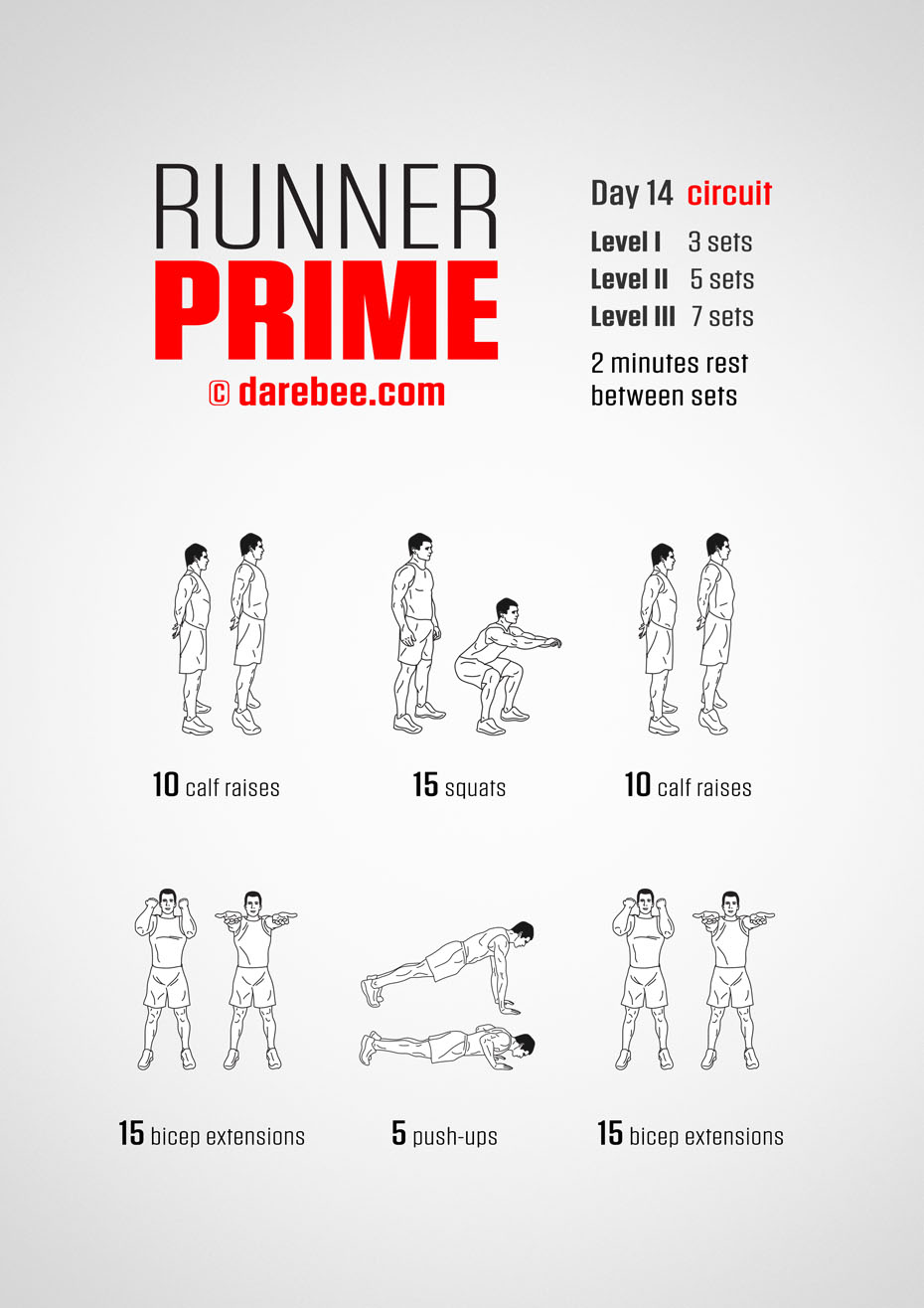
Day 14 is a circuit, 3, 5 or 7 sets, 2 minutes rest, and for the first time the calf raises take the outside of the sandwich: 10 calf raises, 15 squats, 10 calf raises, then 15 bicep extensions, 5 push-ups, 15 bicep extensions. That is 20 calf raises and 30 bicep extensions per set, with squats and push-ups in the middle.
The squats have come down from 20 per set on Day 2 to 15, but the calves are up from 10 to 20 - the card is quietly rebalancing toward the lower leg. Bicep extensions are new: standing, fists pulled in tight to the shoulders, you drive both arms straight out to the sides at shoulder height and pull them back in, keeping the arms tense in both directions. Without a weight, the tension you supply is the resistance, and 30 per set is enough time under it to matter. Arm strength shows up in the run as arms that keep driving when the legs get tired.
Squat below parallel if your hips allow it, chest up, heels planted. Rise high on the calf raises and lower slowly. In bicep extensions, clench your fists, squeeze the whole arm as it extends, and keep the elbows at shoulder height rather than letting them sink. Push-ups full range, five clean reps.
The calves take the bookends now and the arms get a job - two weeks in, the circuit is redistributing the work.
Make it Harder: Do the bicep extensions at a slow three-count out and a three-count back, tension never dropping.
Make it Easier: Cut the bicep extensions to 8 per set and the squats to 10.

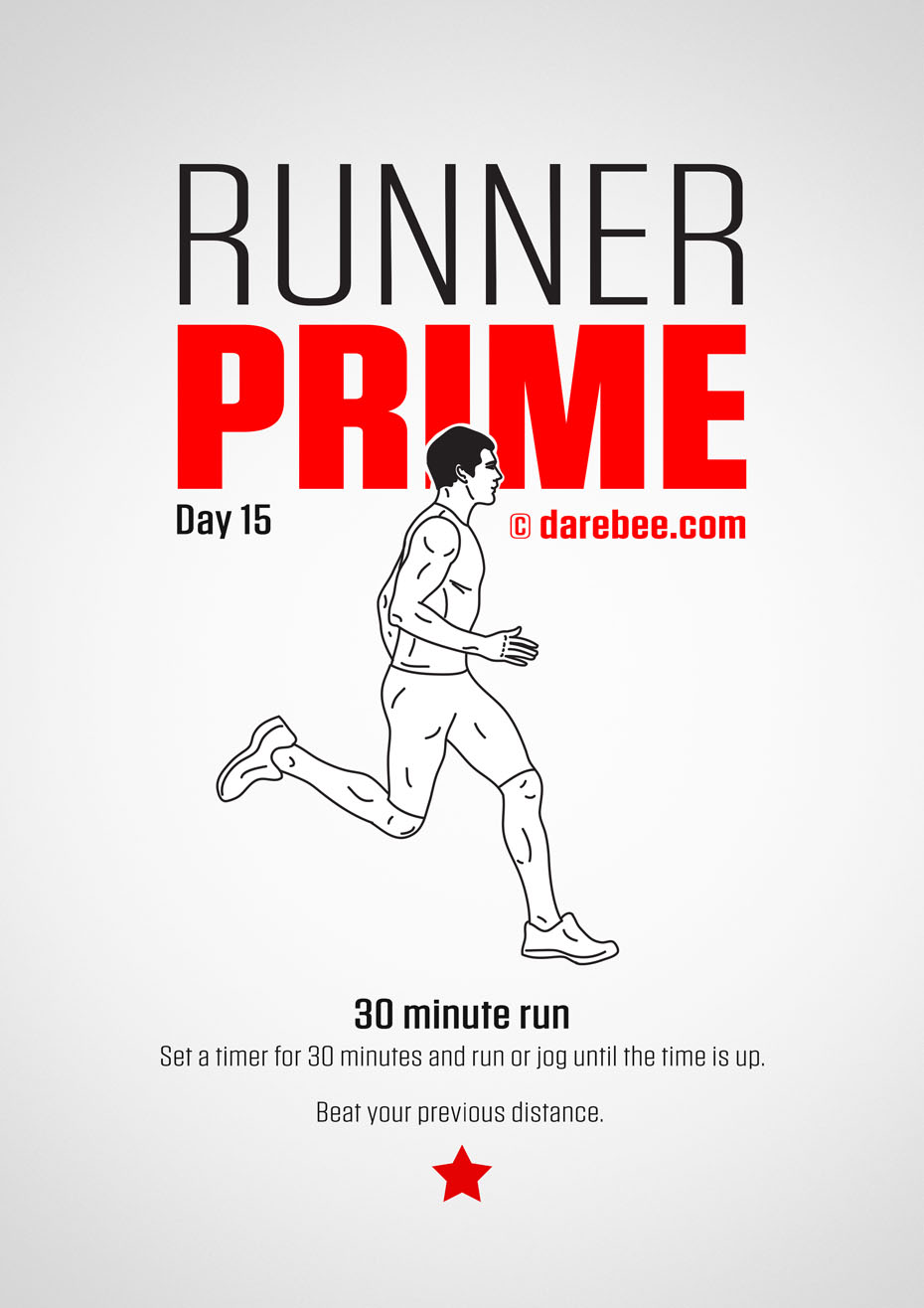
Day 15 is a red star: 30 minutes, run or jog, beat Day 13's distance. Halfway point of the program, and the fourth time the card has asked you to run further in the same time.
By now the target is a real number with a history behind it, so plan around it. Divide Day 13's distance by 30 to get metres per minute, add whatever margin you are chasing, and you have a pace to hold rather than a vague instruction to try harder. That small piece of arithmetic is the whole difference between hoping to beat a distance and knowing how. Runners who learn to run to a number rather than to a feeling stop leaking time in the middle miles.
Warm up with three or four easy minutes before the timer starts if you can, so the first minutes of the 30 are already useful. Then settle onto the pace you worked out and hold it. If you have a device that shows pace, glance at it every few minutes; if you do not, use landmarks from Day 13 and note whether you reach them earlier. Record the result.
Halfway there, and the run now comes with a plan instead of a hope.
Make it Harder: Take whatever pace Day 13 produced, make it 10 seconds per kilometre quicker, and hold that for the full 30.
Make it Easier: Take a one-minute walk break at the 15-minute mark and still aim to pass Day 13's distance by a few metres.

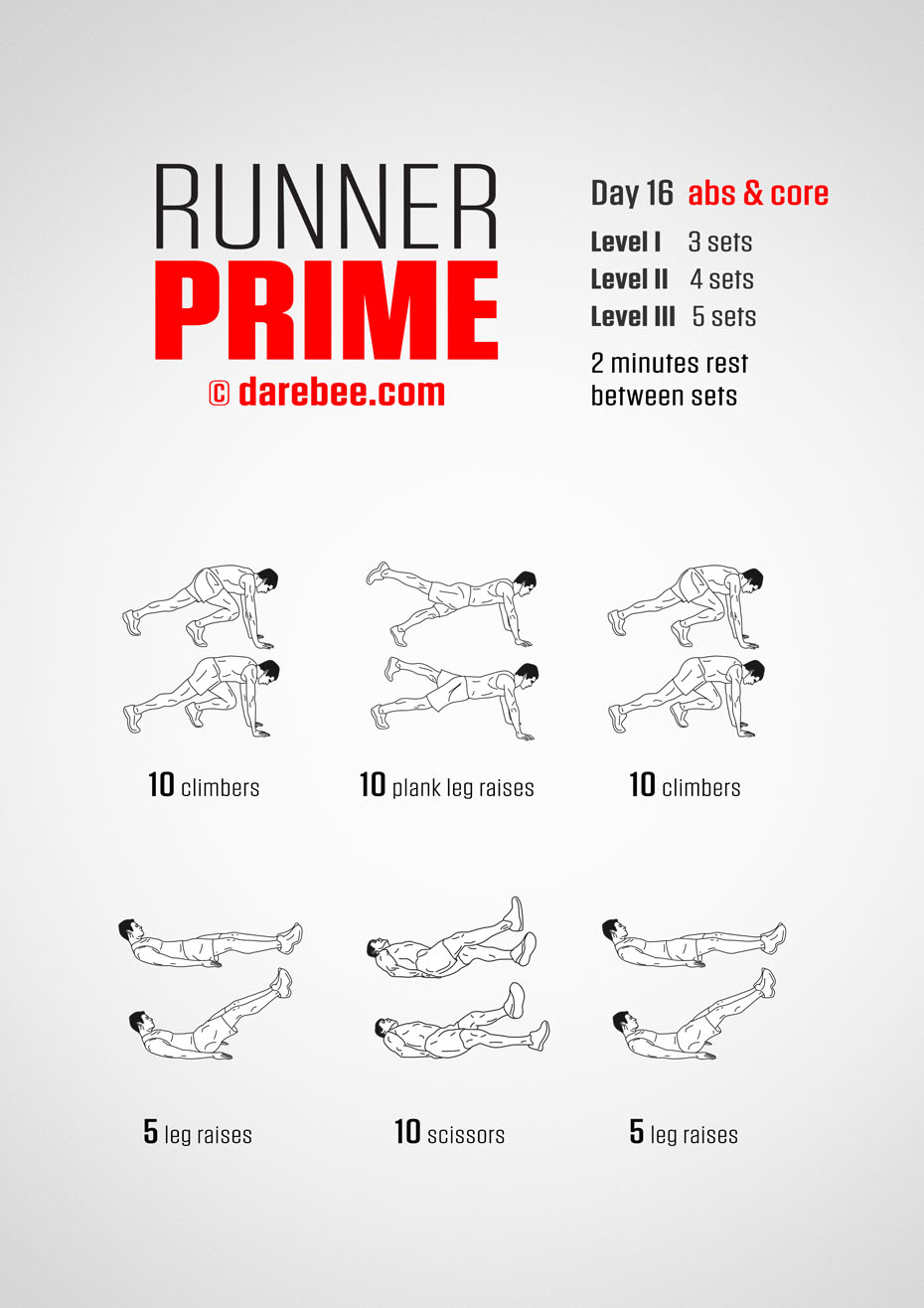
Day 16 is an abs & core circuit, 3, 4 or 5 sets, 2 minutes rest, and it is the first core day to leave your back for a plank. The top row is 10 climbers, 10 plank leg raises, 10 climbers; the bottom row returns to the floor for 5 leg raises, 10 scissors, 5 leg raises. Climbers total 20 per set, leg raises 10.
Climbers are mountain climbers: in a full plank on your hands, drive one knee toward your chest, return it, then the other, alternating quickly - 10 knee drives in all. Plank leg raises hold the same plank while one straight leg lifts behind you and lowers, alternating, 10 lifts total; the trunk has to stay level while a leg leaves the base. Both are running done horizontally: the hip flexing and extending against a braced core. The bottom row goes back to the lower abs. Leg raises are the straight-leg version from Day 8, and scissors hold both legs just off the floor and cross them over each other, right over left, left over right, 10 crosses.
In climbers, keep your hips level with your shoulders - they will want to rise as you tire - and land the feet quietly. In plank leg raises, lift only as high as your lower back allows without arching, and squeeze the glute at the top. On leg raises and scissors, press the lower back into the floor; the moment it lifts, raise the legs higher so it settles.
Plank in the top row, floor in the bottom - the core meets the ground from both sides today.
Make it Harder: Slow the climbers right down and pause with each knee at the chest for a one-count.
Make it Easier: Cut the climbers to 6 per set and lift the plank leg raises from a kneeling position instead.

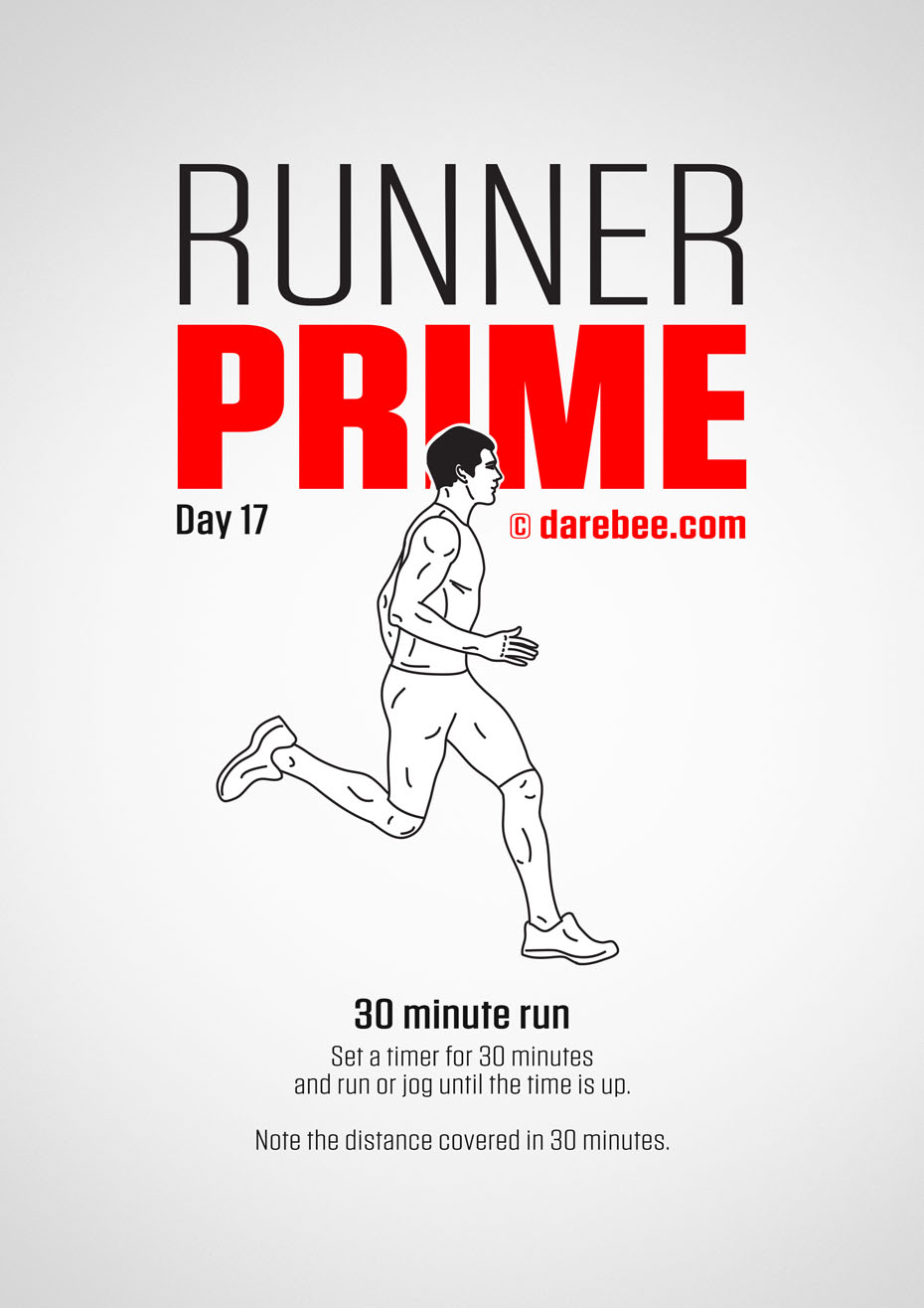
Day 17 is a note run: 30 minutes on the timer, run or jog until it ends, and record the distance. Day 19 will chase it.
Sixteen days of alternating running and training have had a cumulative effect by now, and this is the run where you may feel it - either as fresher legs than you expected or as heavier ones. Both are normal. Yesterday's plank work loads the hip flexors that climbers and leg raises depend on, and those are exactly the muscles that lift your knee on every stride. Give them the first five minutes to loosen before you decide what kind of run this is going to be.
Practise breathing today. Try inhaling for three steps and exhaling for two, so the exhale lands on a different foot each cycle; it spreads the impact of the breath across both sides of the body. If that feels forced, find any pattern you can keep for 30 minutes without thinking about it. Run tall, land light, and note the distance.
A run that listens to the body before it asks anything of it.
Make it Harder: Finish with four short pick-ups of about 20 seconds each, walking between them, before the timer runs out.
Make it Easier: Walk the first five minutes as a warm-up and jog the remaining 25, recording the full distance.

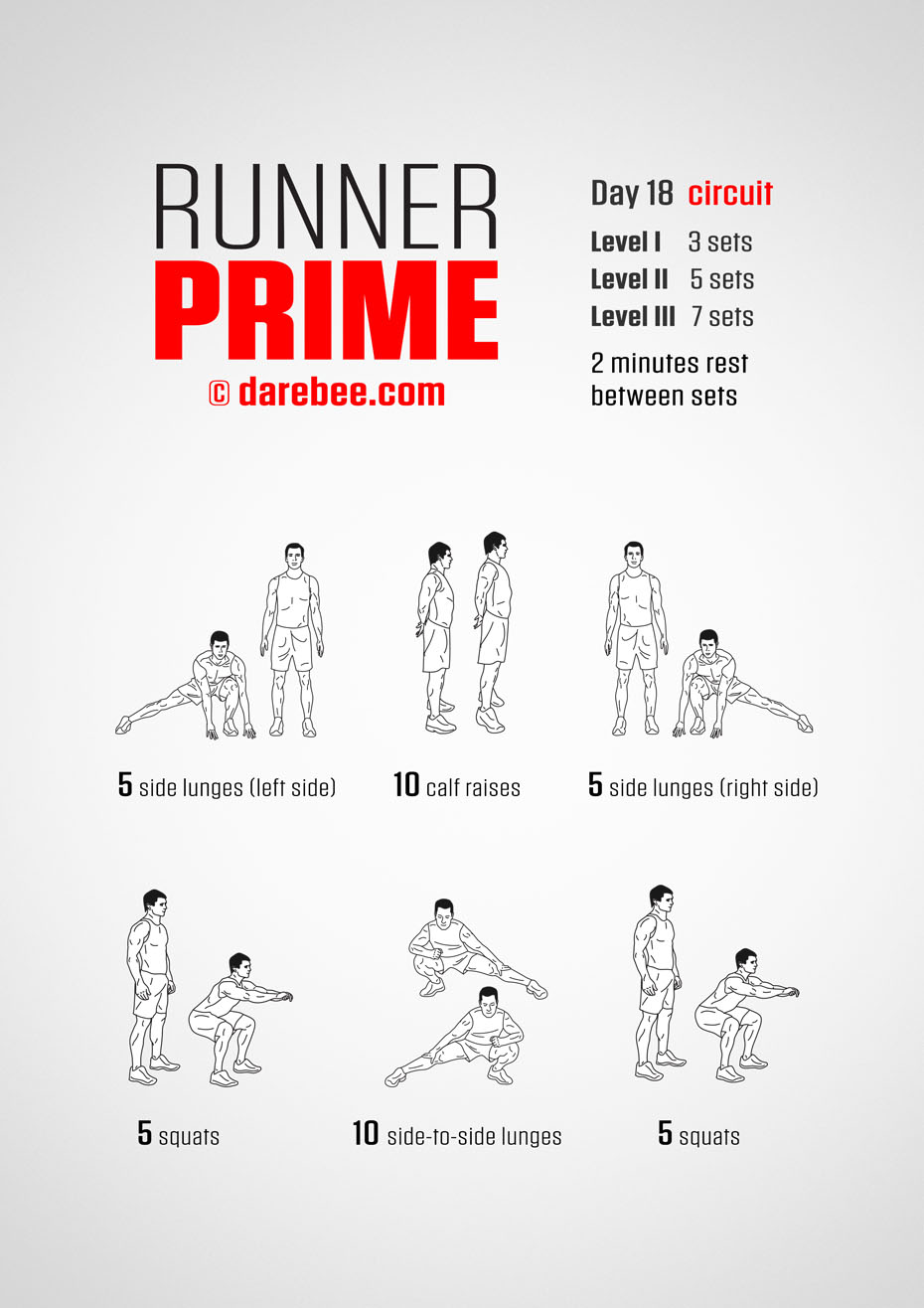
Day 18 is a circuit, 3, 5 or 7 sets, 2 minutes rest, and it is all legs, all standing, all sideways. The top row is 5 side lunges to the left, 10 calf raises, 5 side lunges to the right. The bottom row is 5 squats, 10 side-to-side lunges, 5 squats. Both lunge counts on this card mean what they say: side lunges are 5 per side, side-to-side lunges are 10 in total, alternating.
The two lunges look alike and are not. A side lunge starts from standing: step wide to one side, sit deep into that leg with the other leg straight, reach your hands toward the floor, and push back up to standing before the next rep. Side-to-side lunges never stand up: you stay low and shift your weight from one bent leg to the other, the straight leg swapping each time, 10 shifts in all. The first teaches you to absorb a sideways step; the second keeps the inner thighs and hips under continuous tension. Calf raises and squats around them keep the whole leg working in the plane it knows.
In side lunges, keep the bent knee tracking over the foot and the straight leg's foot flat. In side-to-side lunges, keep your chest up and your hips low the whole way across - the temptation is to rise as you shift, and rising is rest. Squats to parallel or below, heels down. Calf raises full range.
A running program that spends a day going sideways is protecting every stride that goes forward.
Make it Harder: Add a small hop as you shift on every side-to-side lunge, landing soft and staying low.
Make it Easier: Rest your hands on your thighs during the side-to-side lunges and stay a little higher than the picture shows.

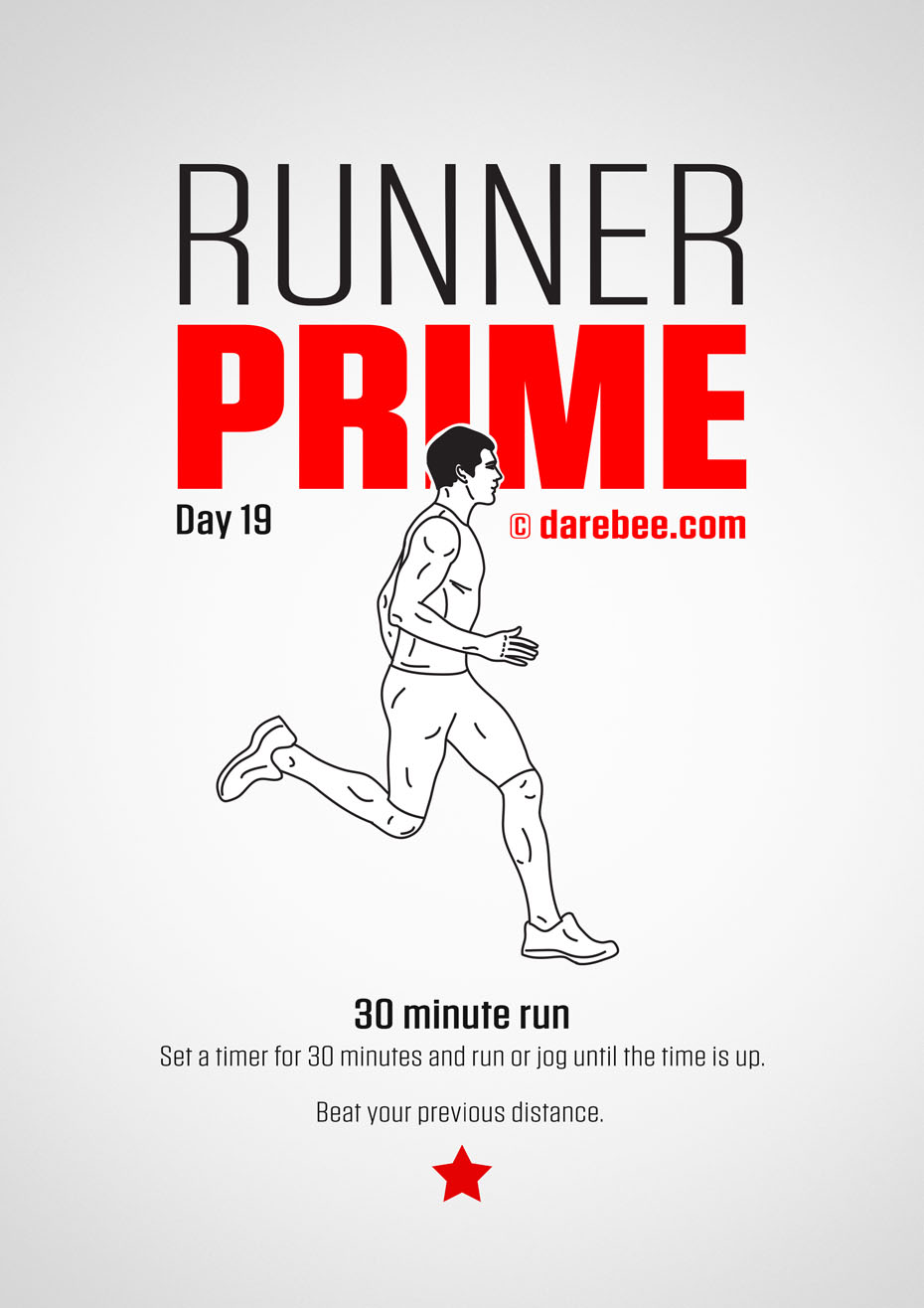
Day 19 is a red star. Thirty minutes, run or jog, beat the distance from Day 17.
Yesterday was a hard leg day, and the program knows it: the fifth star arrives with the hips and inner thighs still feeling Day 18. That is not an accident so much as the reality of running - race days rarely follow perfect rest, and a runner who can produce a slightly better run on ordinary legs is a runner who has learned something. Start easy, let the stiffness go, and trust that the distance is there in the second half once you are warm.
Cadence is your friend on tired legs. Shorten the stride, quicken the turnover, and let the extra metres come from more steps rather than longer ones. Keep the arms driving so the legs have a rhythm to follow. Look for Day 17's landmarks and note whether you reach them sooner. Record the distance when the timer sounds.
A better run on legs that trained yesterday - that is what the star is really measuring.
Make it Harder: Run blind: no pace or distance checks until the timer ends, and still finish ahead of Day 17.
Make it Easier: Treat the first ten minutes as a warm-up jog on stiff legs and only start the real run at minute ten.

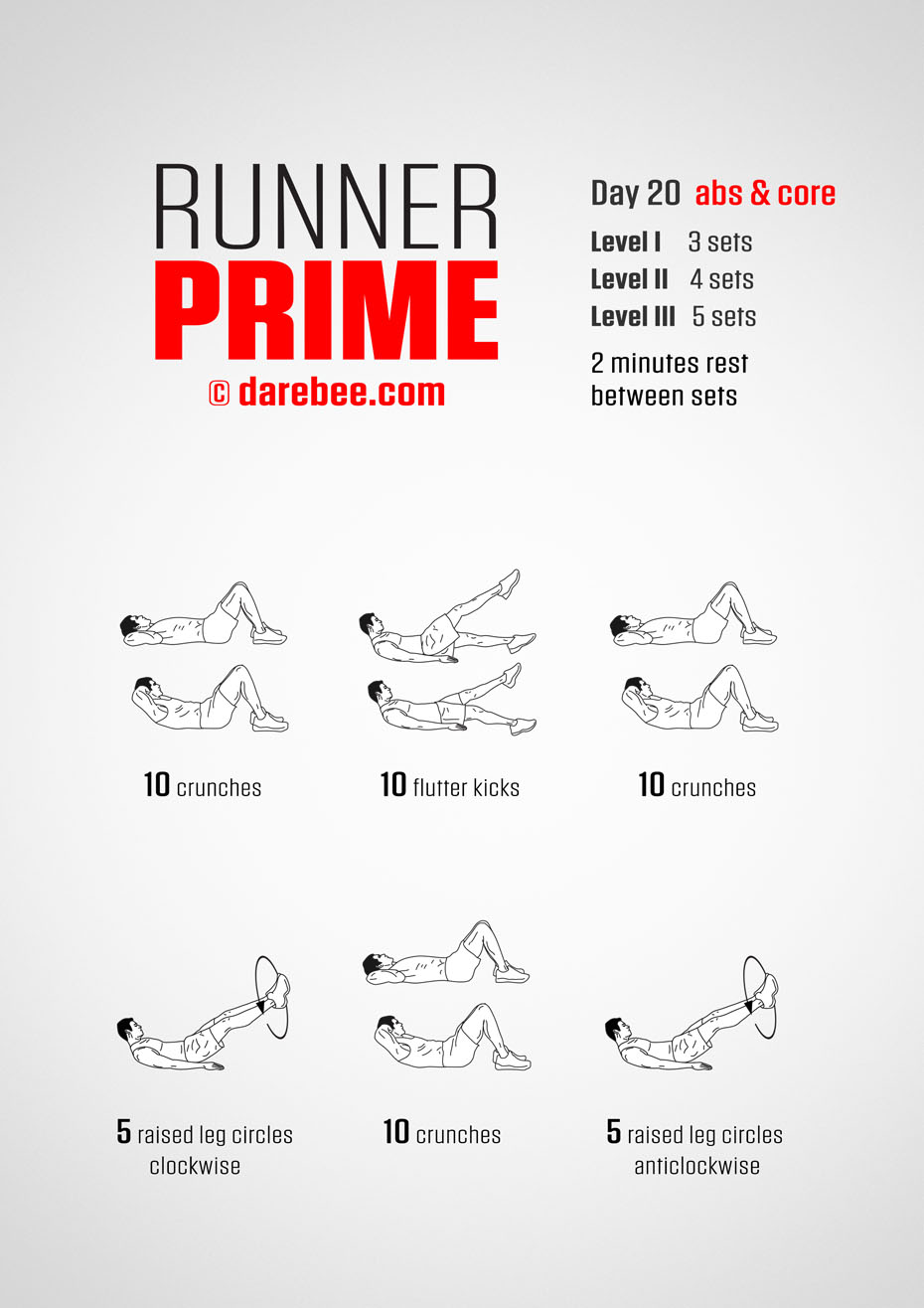
Day 20 is an abs & core circuit, 3, 4 or 5 sets, 2 minutes rest, and it hands the card to the crunches: 10 crunches, 10 flutter kicks, 10 crunches, 5 raised leg circles clockwise, 10 crunches, 5 raised leg circles anticlockwise. Three rounds of crunches make 30 per set, the same as Day 4, with the leg work in between.
The pattern is upper abs, lower abs, upper abs, all the way down the card. Crunches curl the shoulders up; flutter kicks hold both legs just off the floor and kick them alternately, 10 kicks; and raised leg circles are new: lying back with your shoulders slightly lifted and your hands by your hips, legs together and raised, you draw a circle in the air with both feet, 5 circles clockwise in the first position and 5 anticlockwise in the last. Circles ask the abs to hold the legs up while the direction of the load keeps changing, which is a different demand from lifting and lowering.
Crunches stay small, with the lower back on the floor and the lift coming from the ribs. Keep the flutter kicks low and quick. For leg circles, make the circles large enough to feel the abs work at the bottom of each one, keep the legs together, and if your lower back lifts, make the circles smaller rather than stopping.
Clockwise, anticlockwise and 30 crunches in between - the abs get turned in every direction.
Make it Harder: Draw the leg circles as large as your range allows, with your feet skimming just above the floor at the bottom of each one.
Make it Easier: Keep your knees bent for the leg circles and reduce the crunches to 6 per position.

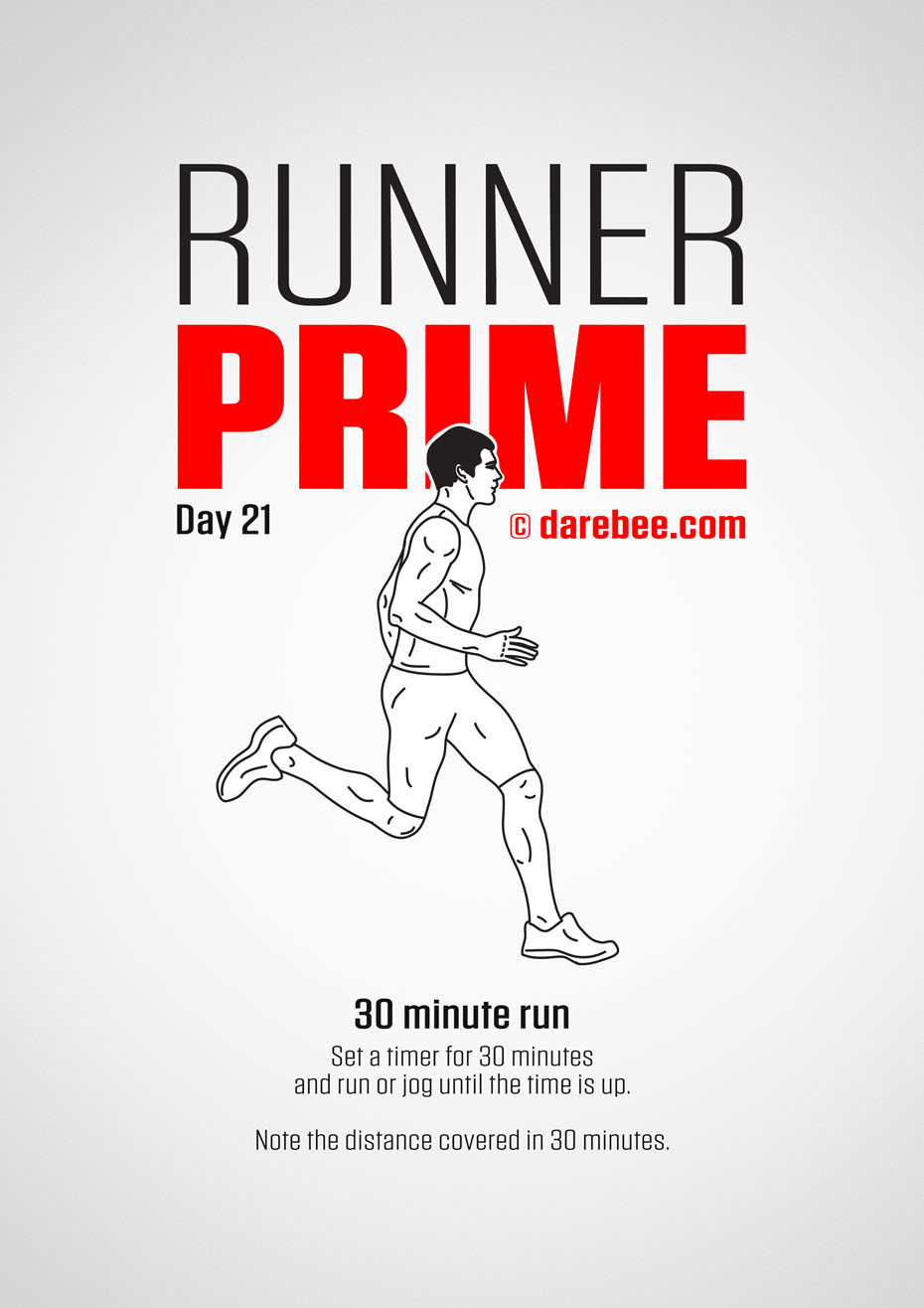
Day 21 is a note-the-distance run: 30 minutes, run or jog, record the number. It sets the mark for Day 23.
Three weeks in, this is the run to notice what has become automatic. The timer, the route, the recording - none of it needs thought anymore, and that frees attention for the run itself. Use it. Notice your foot strike, where your eyes are, whether your shoulders have climbed. Twenty days ago all of this competed for attention with simply getting through 30 minutes; now the 30 minutes is the easy part.
Try running by feel with no pace information at all and guess your distance before you look at it. The gap between the guess and the number is a measure of how well you know your own pace, and it closes with practice. Stay relaxed, keep the cadence quick, and record what you covered.
Three weeks of runs, and the clock is no longer the thing you are running against.
Make it Harder: Run the whole 30 minutes on grass, trail or sand and record the distance without adjusting for the surface.
Make it Easier: Run for 25 minutes and walk the last five, noting the total distance as usual.

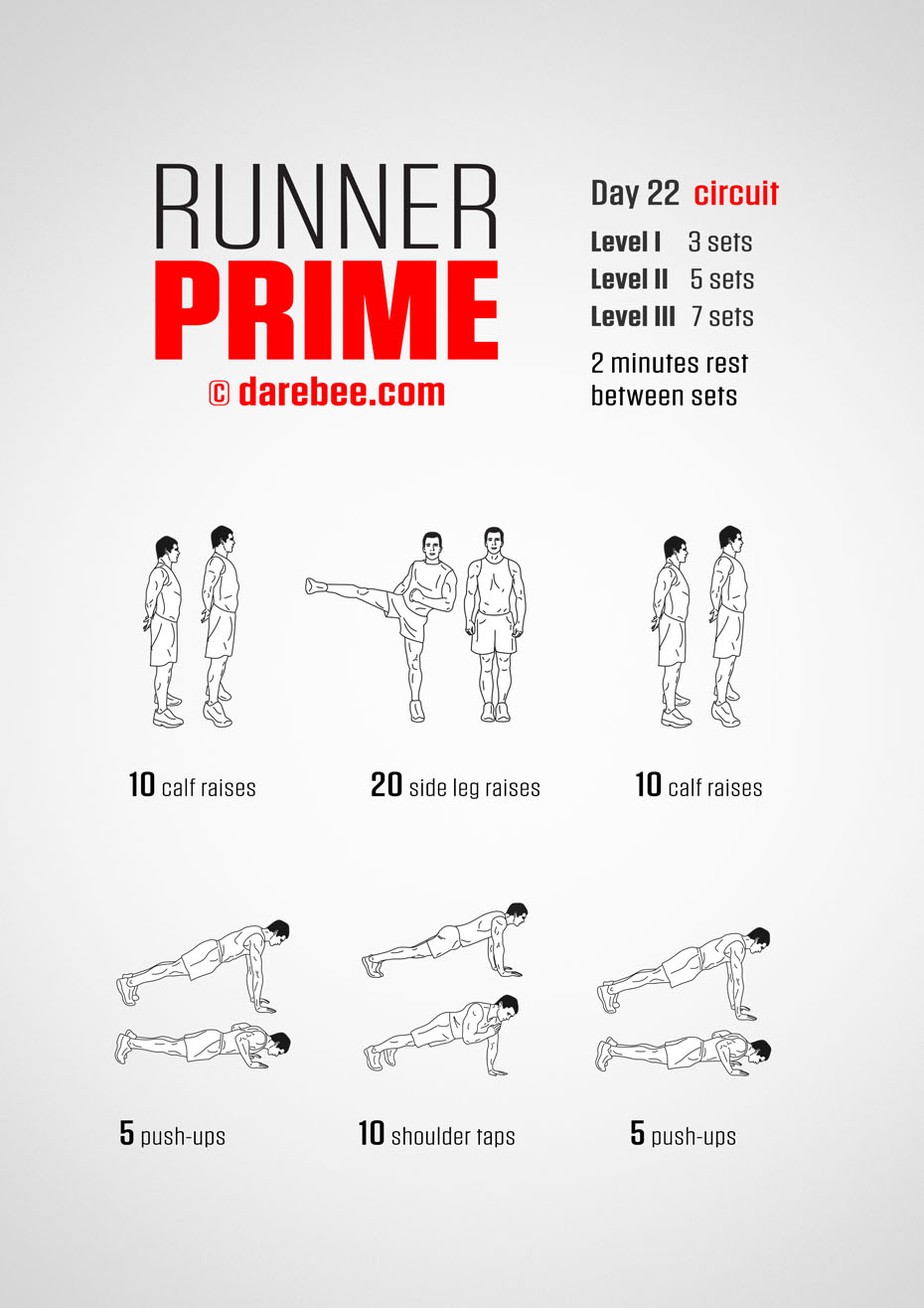
Day 22 is a circuit, 3, 5 or 7 sets, 2 minutes rest, and both rows flip the pairings from earlier cards. The top row is 10 calf raises, 20 side leg raises, 10 calf raises; the bottom row is 5 push-ups, 10 shoulder taps, 5 push-ups. The push-ups take the outside this time, so each set carries 10 of them, twice Day 2's count.
The side leg raises are the standing version from Day 10, but the count is now a single 20 with no side named, so alternate legs on every rep: lift right, lower, lift left, lower, 10 each. That means the standing leg changes every rep as well, which keeps both hips switching between lifting and stabilising instead of doing one job for a full set. Calf raises around them bring the lower legs to 20 per set. The bottom row is Day 2's plank pairing reversed: push-ups on the outside, shoulder taps in the middle. Same exercises, different order, and the push-ups arriving fresh at the start of the row make a difference.
Stand tall through the alternating leg raises; each switch is a chance to lean, so do not. Calf raises to full height, lowered slowly. Push-ups chest low, elbows tucked, body in one line, and go straight into the shoulder taps without letting the hips sag in the transition.
Same pieces as Day 2 and Day 10, rearranged so the push-ups finally get the bookends.
Make it Harder: Do the push-ups with your hands close together under your chest, elbows brushing your ribs.
Make it Easier: Cut the side leg raises to 10 per set and do 3 push-ups in each position instead of 5.

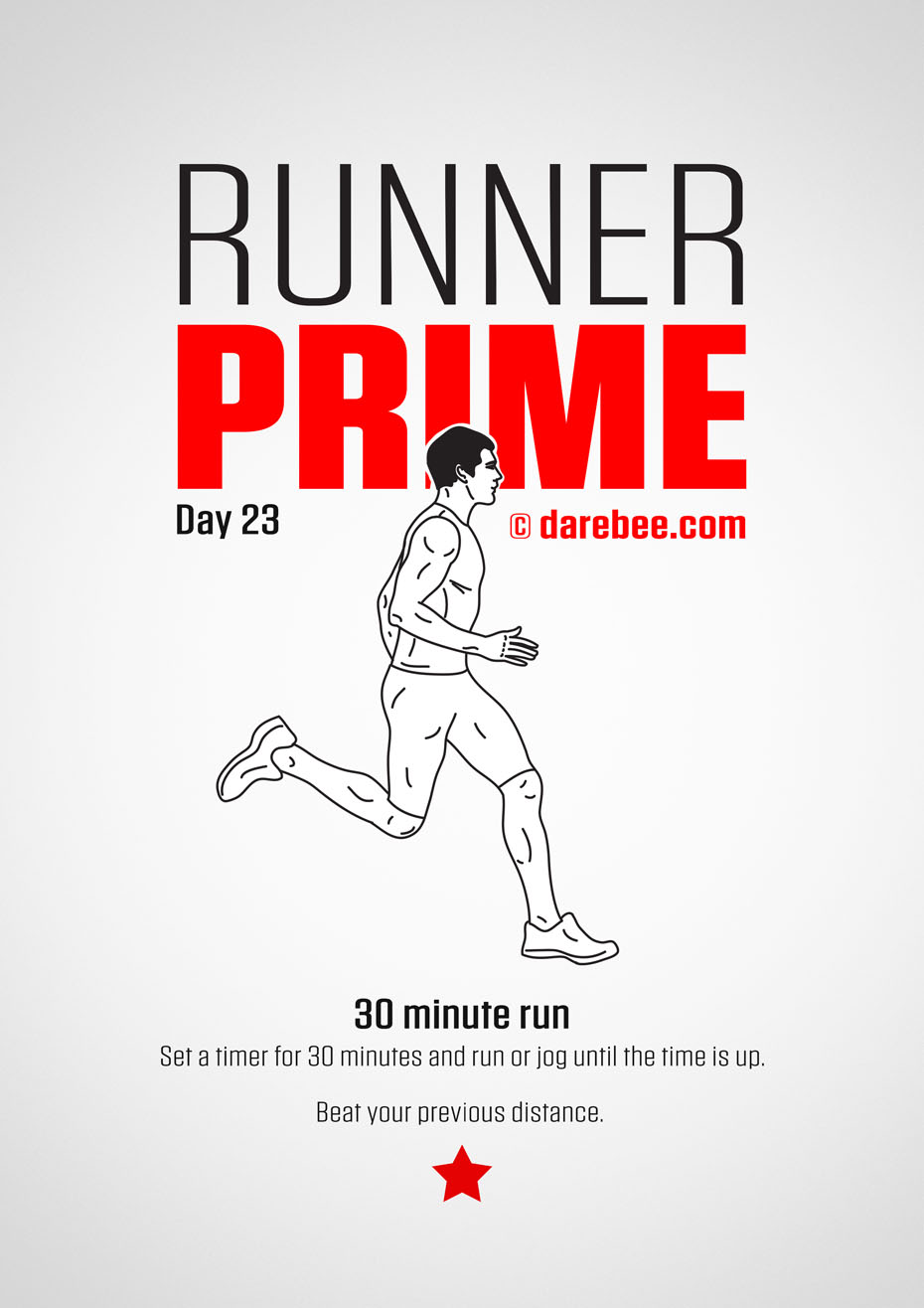
Day 23 is a red star run: 30 minutes, run or jog, beat Day 21's distance. Six stars in, and the last full week of the program starts here.
If you guessed your distance on Day 21 before looking, you now have a sense of your own pace that most runners never develop, and this is the run to use it. Set out at what feels like Day 21's effort plus a notch, and check the number only at the end. The stars are meant to teach you to run a little better without being told how, and by now you have your own methods: an even run, a stronger second half, a quicker cadence, whichever has worked. Use the one that has.
Keep the first five minutes deliberately controlled - the star tempts you to go out too fast, and the distance lost to that in the last ten minutes is more than it gains. Breathe in rhythm, relax the hands, drive the arms. When the timer stops, compare and record.
The sixth star, and the method for beating it is finally yours rather than the card's.
Make it Harder: Beat Day 21 on a harder route than the one you ran it on.
Make it Easier: Take walk breaks whenever you need them, but keep each one under 30 seconds so the distance stays within reach.

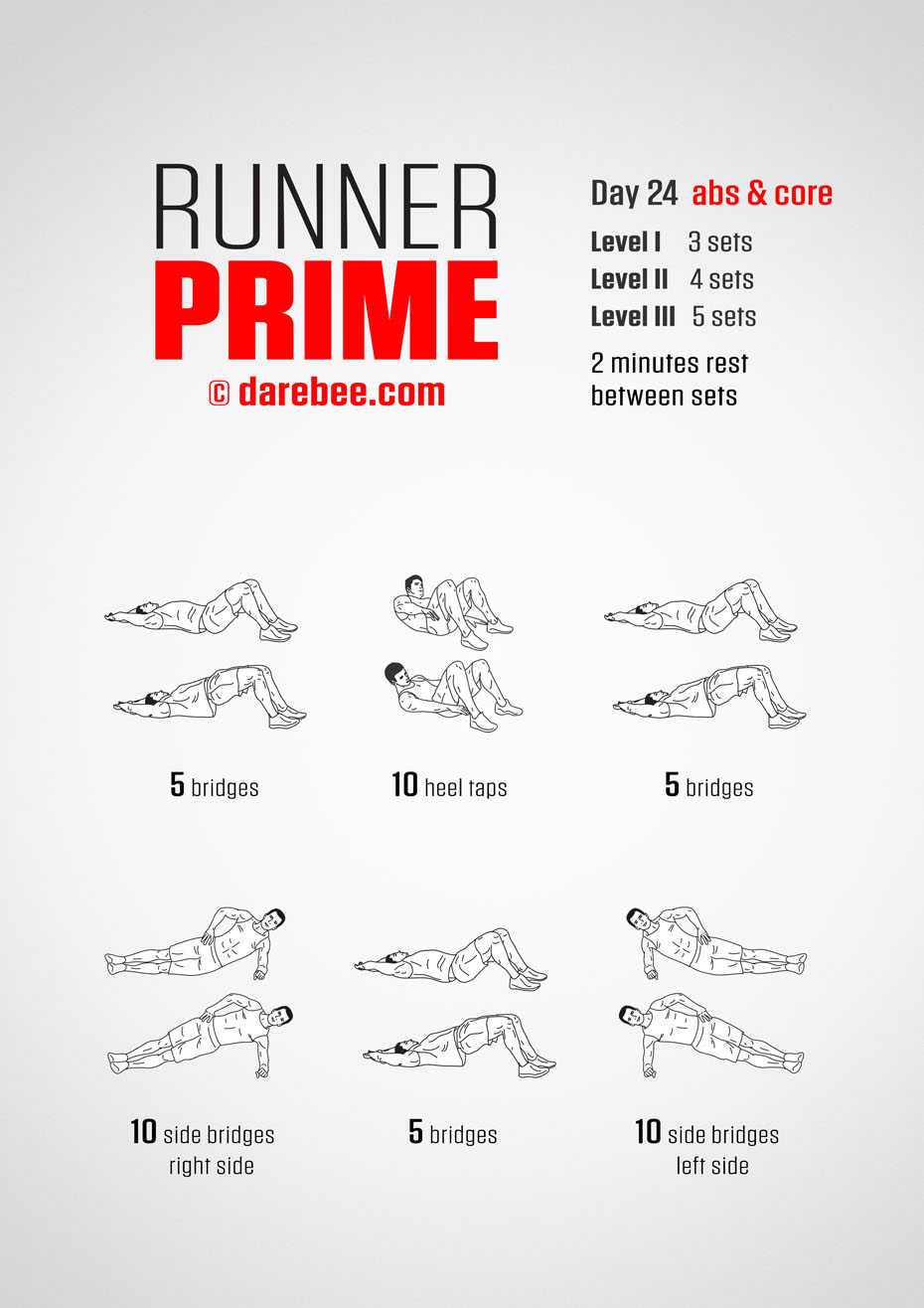
Day 24 is an abs & core circuit, 3, 4 or 5 sets, 2 minutes rest, and it belongs to the bridges: 5 bridges, 10 heel taps, 5 bridges, 10 side bridges on the right, 5 bridges, 10 side bridges on the left. Bridges appear three times for 15 per set; the side bridges are stated per side, 10 each.
This is Day 12's exercise list with the emphasis shifted from the abs to the glutes. Bridges do the same job as before - hips driven up from a bent-knee lie, squeezed at the top, lowered slowly - but now they run through the whole card, between the heel taps and around the side bridges. Heel taps have come down from 20 on Day 4 to 10, and they carry the abs work alone today. The side bridges are unchanged: on the forearm, hips lifting and lowering, one side then the other, the outer hip and obliques holding the line.
Full hip extension on every bridge; a bridge that stops halfway trains almost nothing. Keep the lower back down and the reach honest on heel taps. In side bridges, keep the shoulder stacked over the elbow and the hips moving in a straight vertical line, and do not let the top hip roll forward.
Fifteen bridges wrapped around the sides and the front - the glutes are the headline today.
Make it Harder: Do every bridge on your heels only, toes pulled up off the floor for the entire set.
Make it Easier: Reduce the side bridges to 6 per side; bridges stay at 5 in every position.

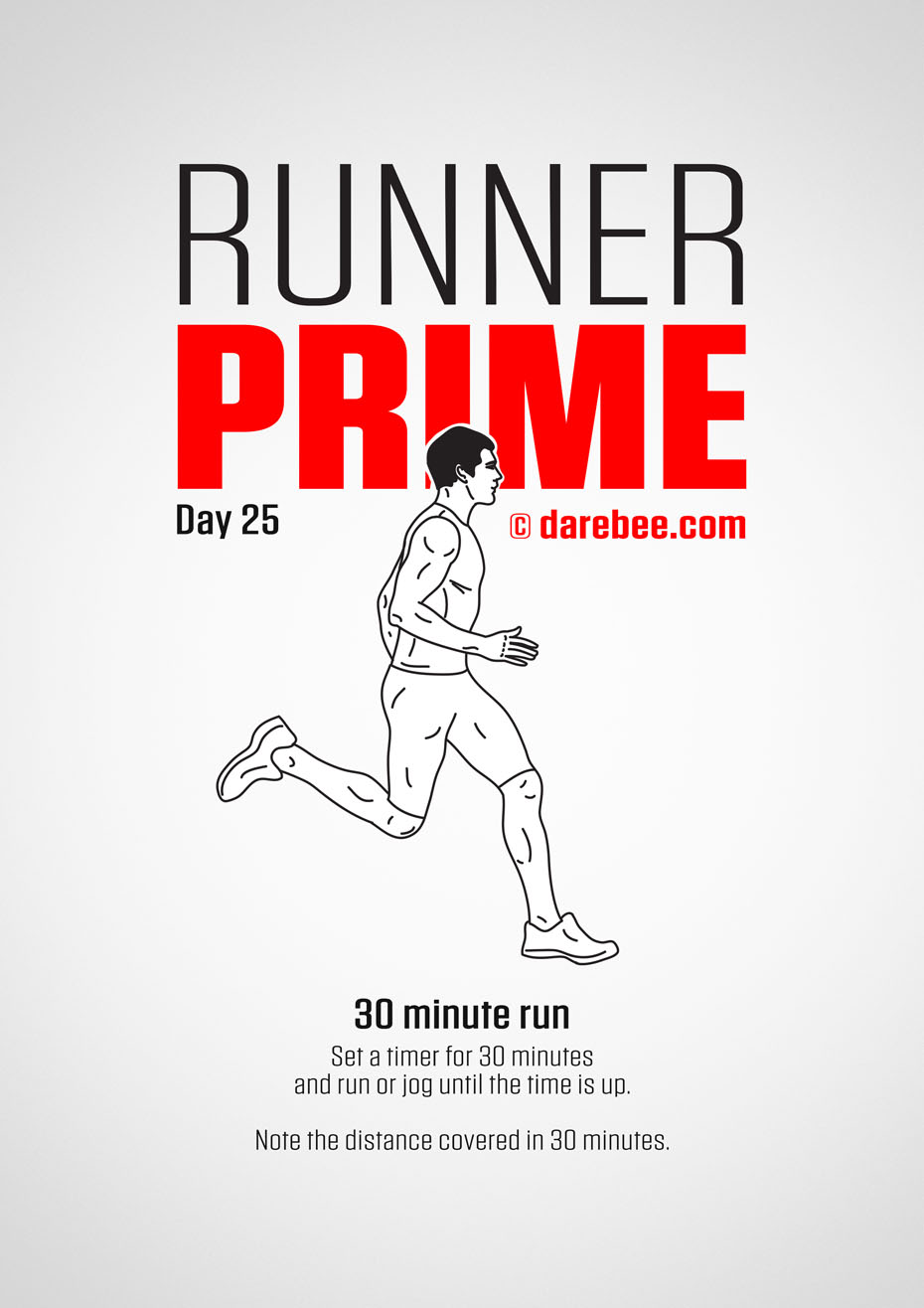
Day 25 is a note run. Thirty minutes, run or jog, record the distance. It sets the target for Day 27.
Two plain runs remain in the program, this and Day 29, and both set up stars. That gives them a strategic weight: whatever you post here decides how hard Day 27 will be, and the same goes for Day 29 and the final run on Day 31. There is no correct choice. A steady honest run sets a fair target; a relaxed one gives the star room to shine; a hard one tests the star properly. What matters is that the choice is deliberate.
Run this one for form. Tall spine, eyes up, elbows back, feet landing beneath you at a quick cadence. Every few minutes check one thing and fix it if it has slipped. Record the distance and the route.
The last-but-one baseline, and every metre of it is a decision about Day 27.
Make it Harder: Run it firmly enough that beating it on Day 27 will take a real effort.
Make it Easier: Keep the whole run easy enough that you finish feeling you could go again.

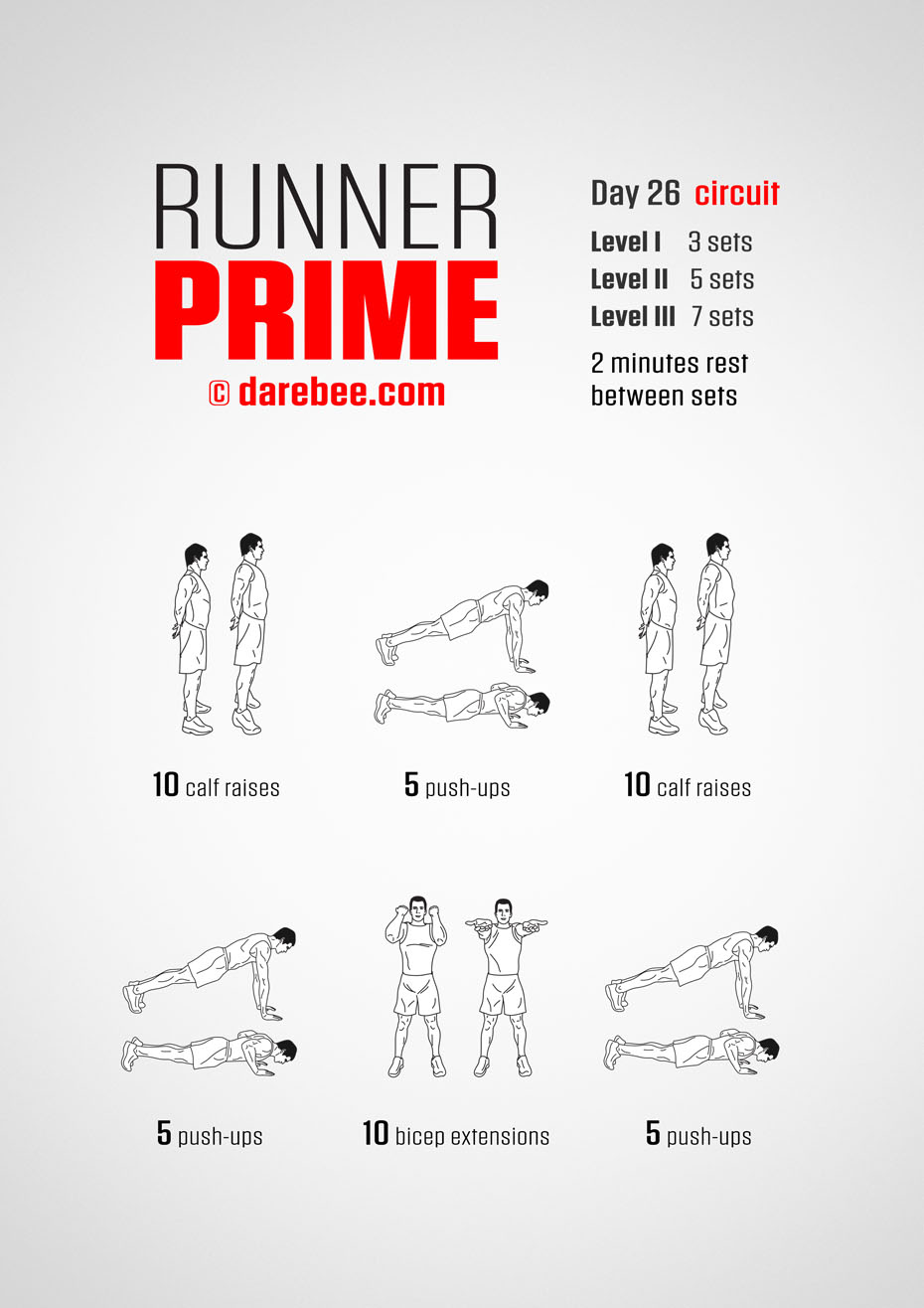
Day 26 is a circuit, 3, 5 or 7 sets, 2 minutes rest, and it breaks the sandwich pattern for the first time. The top row is 10 calf raises, 5 push-ups, 10 calf raises; the bottom row is 5 push-ups, 10 bicep extensions, 5 push-ups. Push-ups appear in three positions, 15 per set, the most in the program; at Level III that is 105 push-ups across 7 sets.
The push-up count has climbed from 5 per set on Days 2, 10 and 14, to 10 on Day 22, to 15 today, and the way it climbs matters: never more than 5 at a time, always with something else in between. Calf raises and bicep extensions give the chest and arms a breather without giving them a rest, since bicep extensions hold the arms under their own tension the whole time. The legs get 20 calf raises, the same as Day 14 and Day 22; the running muscles are kept ticking over while the upper body does the day's real work.
Every push-up counts only at full range, so if the fifteenth is shallow, the level was too high today and that is useful information. Elbows tucked, body straight, chest to just above the floor. Calf raises to the top and lowered slowly. Bicep extensions with fists clenched and the whole arm tense in both directions, elbows at shoulder height.
Fifteen push-ups per set, five at a time - the upper body's biggest day on a running program.
Make it Harder: Lift one foot off the floor for each push-up position, switching feet between positions.
Make it Easier: Do all three push-up positions standing, hands against a wall at arm's length.

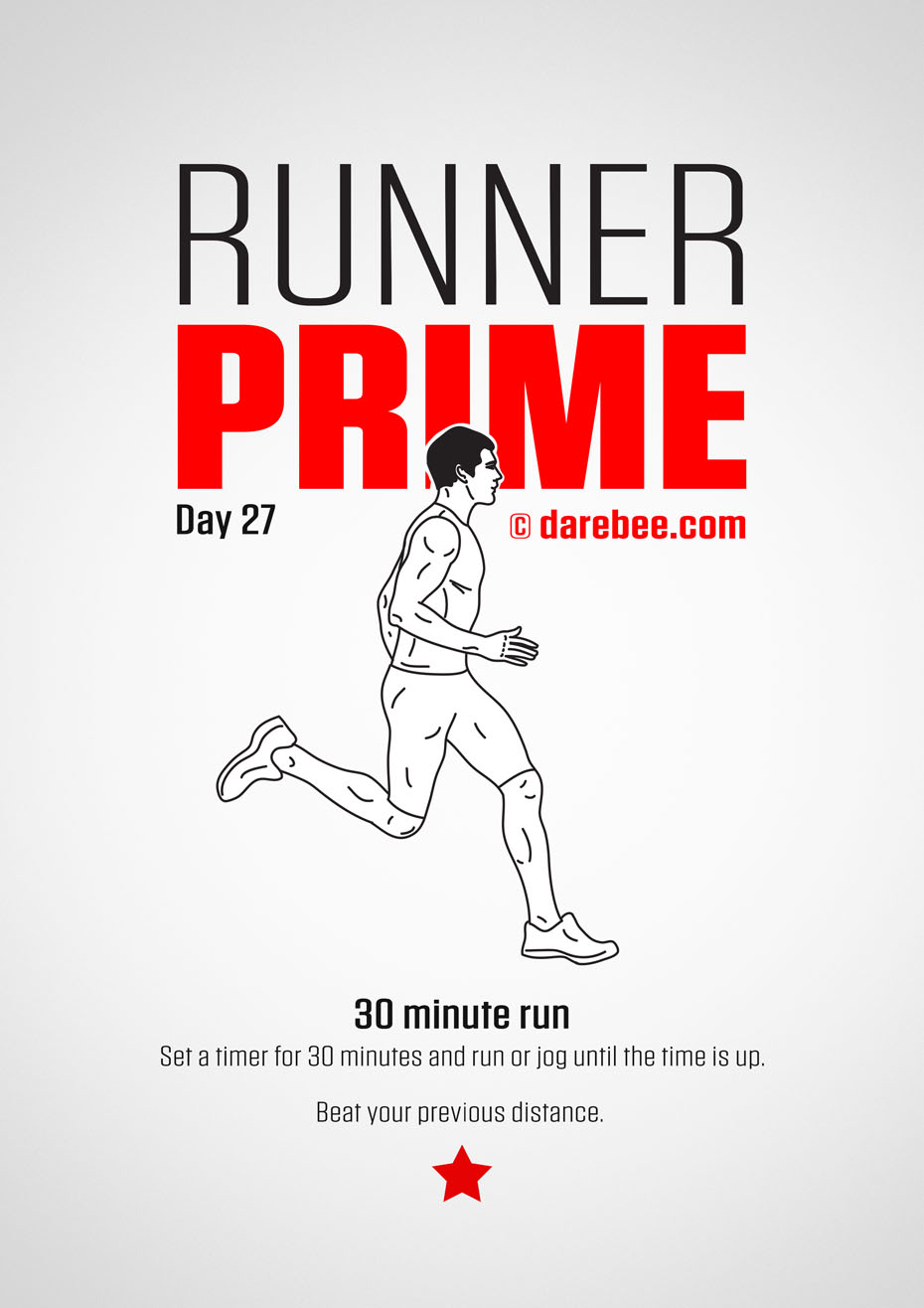
Day 27 is a red star: 30 minutes, run or jog, beat Day 25's distance. Seven of the program's eight stars are done after today.
The upper body took the load yesterday, so the legs arrive at this run fresher than they have at most stars, and it is worth using that. This is the run to test whether the pace judgement the program has been building actually works under pressure: pick the margin you want, work out what it means per minute, and hold it. If you have been beating stars comfortably, ask for more today; if the margins have been thin, aim for a clean small win and bank it.
Warm up before the timer, settle fast, and run even. Shoulders down, hands soft, cadence quick. Look at the number only when the 30 minutes are up. Record it - Day 29 sets the last mark, and Day 31 chases it.
Fresh legs, a known target, and a runner who now knows exactly how to catch it.
Make it Harder: Run the last ten minutes as a steady build so the final minute is the fastest of the run, and still beat Day 25 clearly.
Make it Easier: Choose the route where you have run your best distance so far and run it again at that same pace.

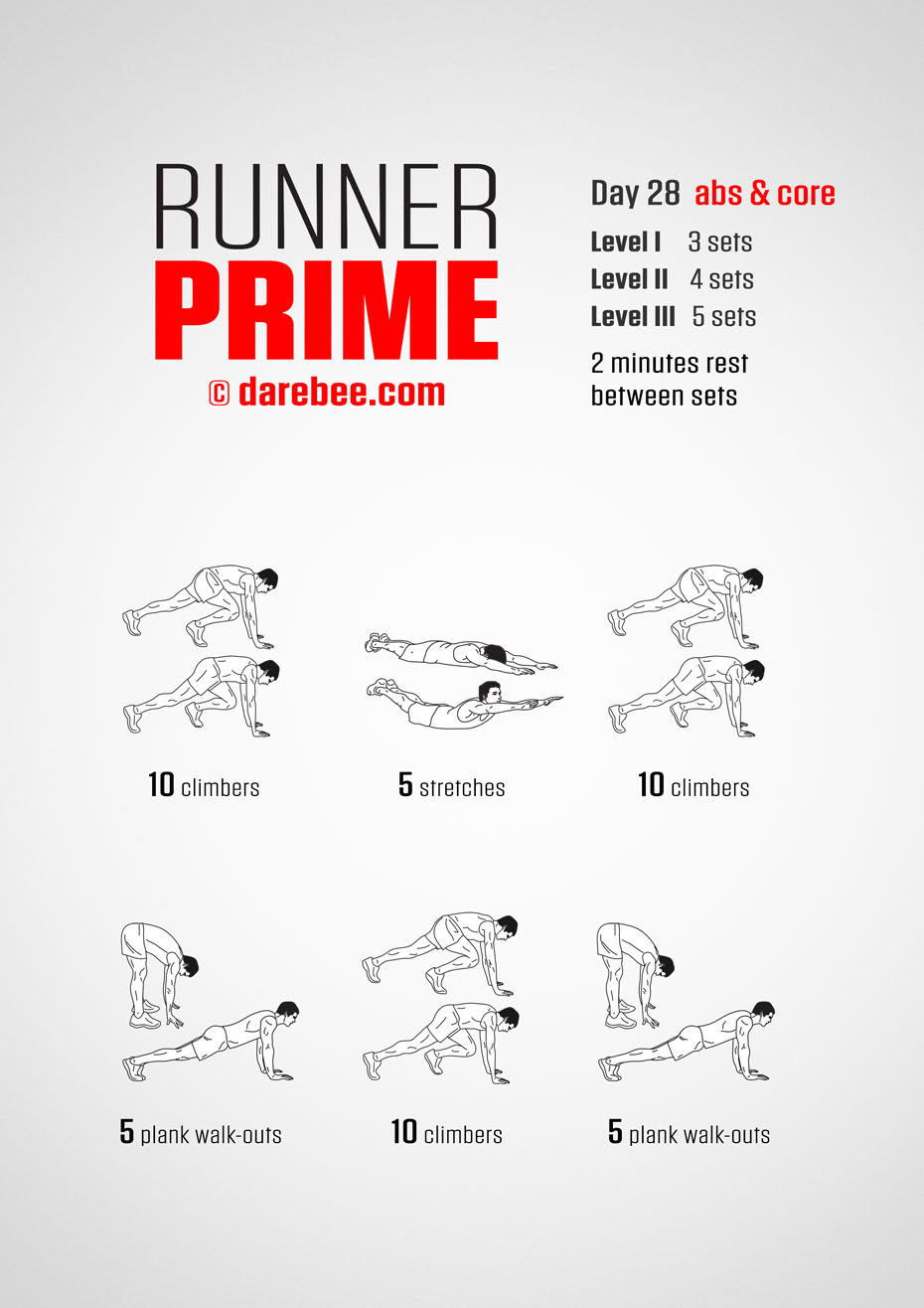
Day 28 is the last abs & core circuit, 3, 4 or 5 sets, 2 minutes rest, and it is almost all plank: 10 climbers, 5 of the prone lifts the card calls stretches, 10 climbers, 5 plank walk-outs, 10 climbers, 5 plank walk-outs. Climbers run through all three positions, 30 per set, up from 20 on Day 16.
Two new exercises join the climbers. The stretches are done face down with your arms extended straight overhead: lift your arms, chest and legs off the floor together, hold for a beat, and lower - a full back extension that works everything behind you from shoulders to hamstrings, and the only exercise on the card that is not a plank. Plank walk-outs start standing: fold forward, put your hands on the floor, walk them out until you are in a full plank, hold it a moment, walk the hands back and stand up tall. Five of those is 10 trips across the floor on your hands. Between the climbers driving knees forward and the walk-outs reaching the whole body long, this is the most movement any core day in the program contains.
Climbers with hips level and knees driving straight, not swinging wide. In the prone lifts, lead with the chest and the thighs rather than the neck or the lower back, and keep the arms straight. In walk-outs, walk the hands out far enough that the plank is a real plank - shoulders over wrists, hips in line - and keep your legs as straight as they will go on the walk back.
Thirty climbers and a walk to plank and back - the last core day makes you cover ground on your hands.
Make it Harder: Add a push-up at the far end of every plank walk-out before walking the hands back.
Make it Easier: Walk the hands out only as far as a high plank with your hips raised, and reduce each climber position to 8.

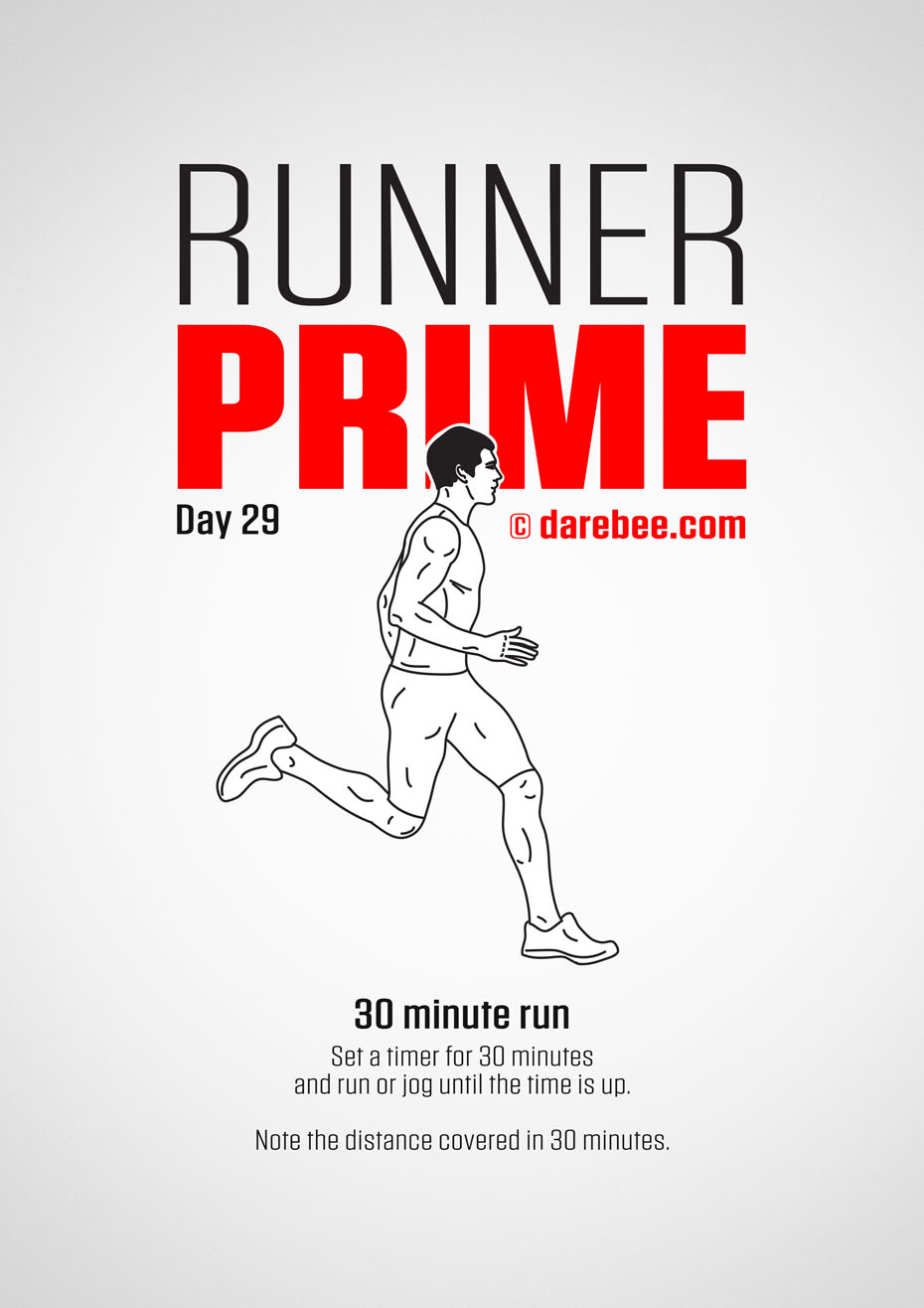
Day 29 is the last note-the-distance run in the program. Thirty minutes, run or jog, record the number. Day 31 will chase it.
This is the baseline for the final star, so it carries some weight. Look back at the seven plain runs before it and the seven stars. If the stars have all beaten their targets, you have been improving for a month and this run should reflect that - not by forcing anything, but by running at what now feels normal and seeing how far that goes. Your normal has moved. Today is the run that shows you how much.
Run it like a rehearsal for Day 31: the same route you intend to use, the same warm-up, the same way of measuring. Eyes up, cadence quick, arms driving, breath in rhythm. Record the distance and set it beside Day 1's - the two numbers are the story of the program.
The final baseline, and a normal run that no longer looks like the one you started with.
Make it Harder: Aim to beat Day 27's starred distance today, even though the card does not ask you to.
Make it Easier: Keep the run indoors or on a track where the pace is easy to control, and hold it deliberately gentle.

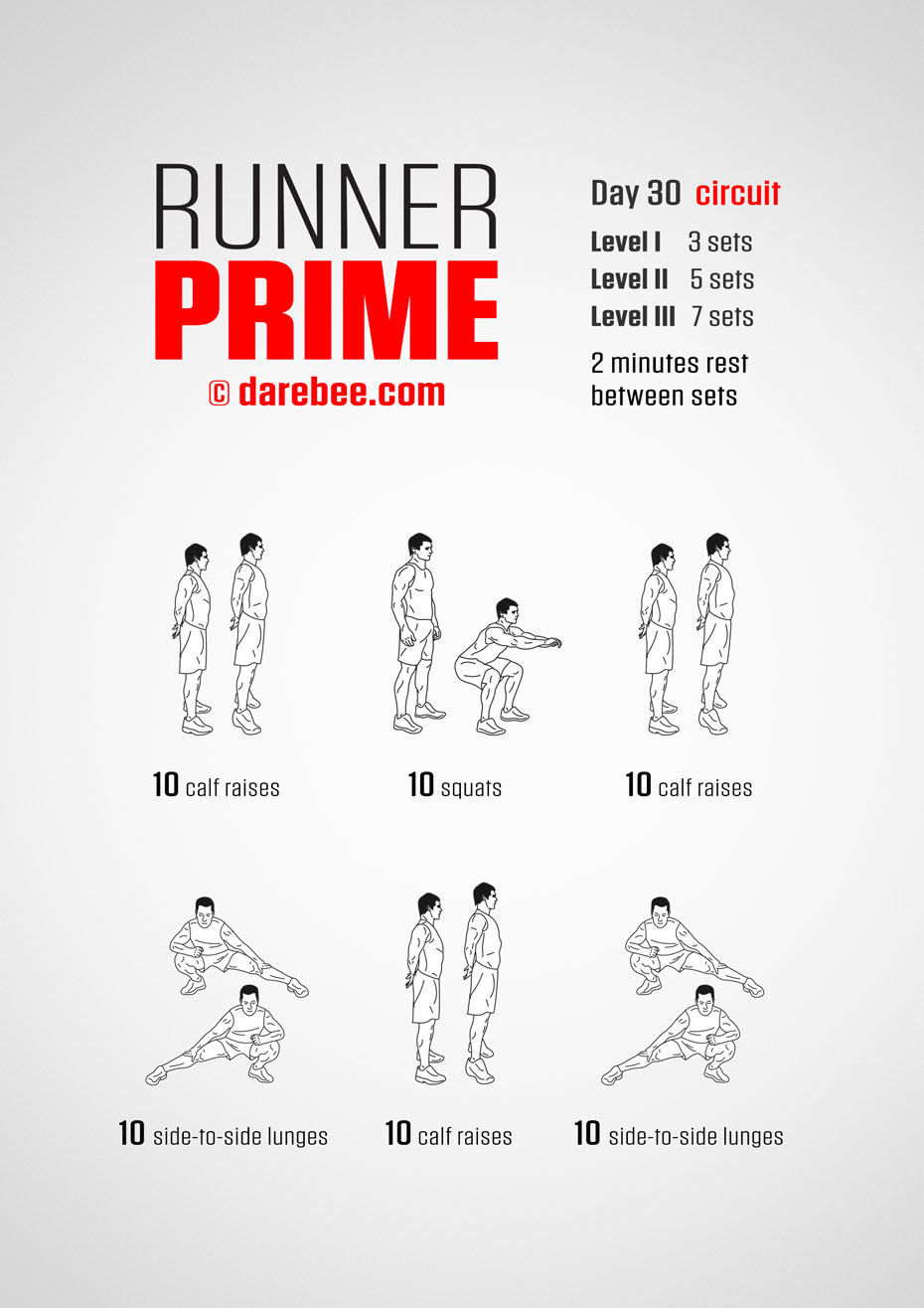
Day 30 is the last circuit, 3, 5 or 7 sets, 2 minutes rest, and it gives the whole card to the legs: 10 calf raises, 10 squats, 10 calf raises, 10 side-to-side lunges, 10 calf raises, 10 side-to-side lunges. Calf raises hold three positions for 30 per set, the highest count on the program, and nothing on the card touches the floor with anything but your feet.
The calf raise has been on every circuit day since Day 2, growing from 10 per set to 20 and now 30, and it ends the program as the exercise that defines it. Calves absorb the landing and drive the push-off on every stride, and 30 raises per set for 3, 5 or 7 sets is a month's worth of that preparation cashed in. Squats return at 10, and the side-to-side lunges from Day 18 return for 20 per set, keeping your hips low and shifting while the calves rest. There is no upper body work at all: the day before the final run is for the legs.
Rise as high as you can on every calf raise and lower over a slow count, because these are the reps that show up tomorrow. Squats to parallel, heels down, chest up. Side-to-side lunges low and continuous, chest lifted, the straight leg's foot flat. If the level you chose leaves your legs heavy for tomorrow, that is worth knowing too.
Thirty calf raises per set the day before the final run - the program saved its most runner-specific card for last.
Make it Harder: Do the third calf raise position one leg at a time, 5 on each.
Make it Easier: Reduce each calf raise position to 6 reps and keep the squats and lunges as written.

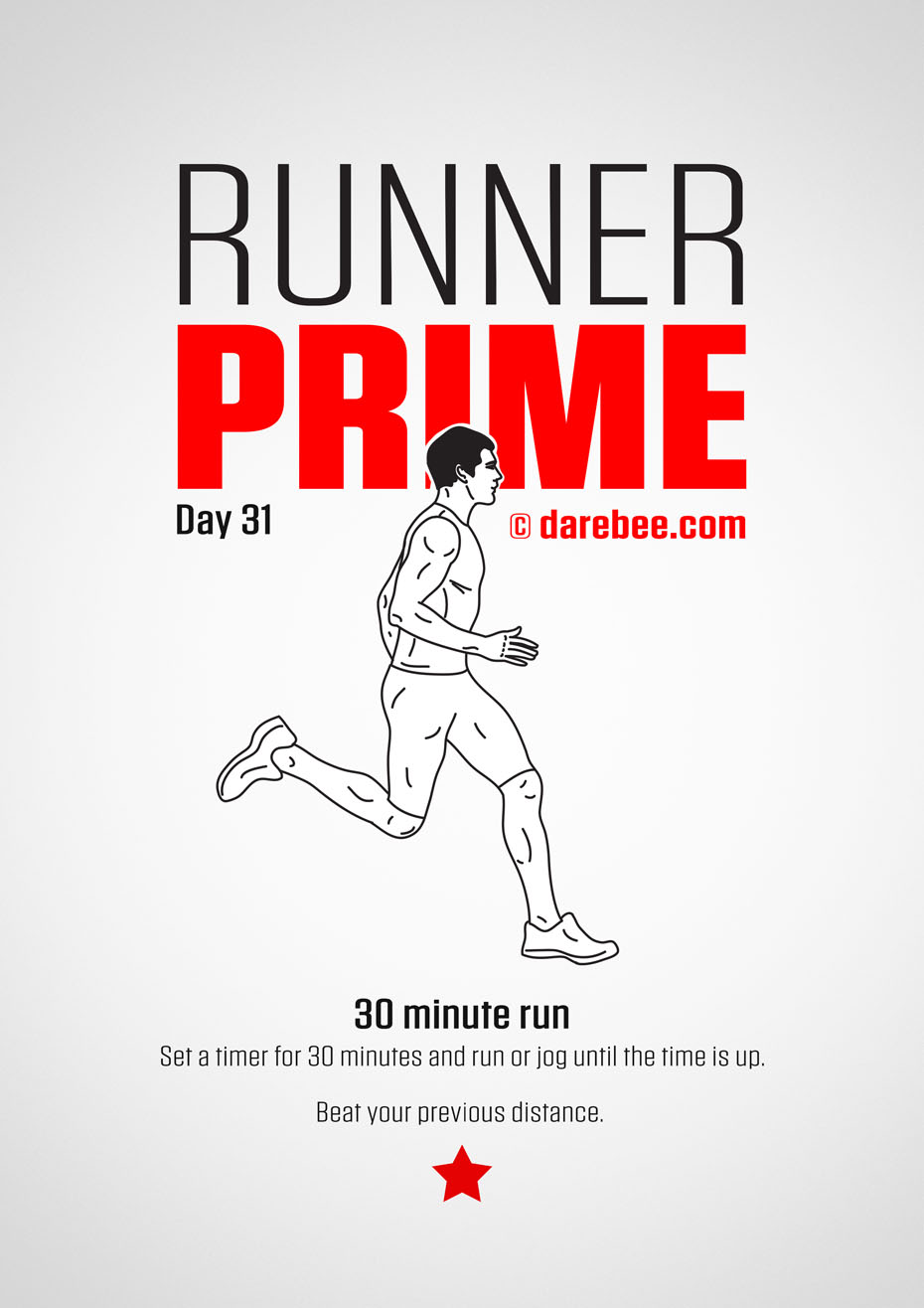
Day 31 is the last run of Runner Prime, and it carries the last red star: 30 minutes, run or jog, beat Day 29's distance. Same timer as Day 1, same instruction to keep moving until it stops, one more number to post.
Before you go, put Day 1's distance next to Day 29's. The difference between them is what 15 training days and 15 runs have done, measured in the most honest unit there is - ground covered in a fixed time. Today's run is not asked to be dramatic, only to be the eighth star in a row that was better than the run before it. Whatever the gap between the first number and today's turns out to be, it was built 50, 100 and 200 metres at a time.
Run it the way the program taught you: warm up, start controlled, hold even, keep the cadence quick and the arms driving, and let the second half be as strong as the first. Record the final distance beside the others. Runner Prime runs on a clean alternation of runs and circuits, so it can be repeated straight away with Day 31's distance as the new Day 1 - or that number can go with you into whatever you run next.
Sixteen runs, eight stars, and the last number on the list is the one you earned.
Make it Harder: Run it as the fastest 30 minutes of the program, beating Day 29 by as much as you have in you.
Make it Easier: Run the 30 minutes exactly as you ran Day 29 and let a month of training make the difference.