
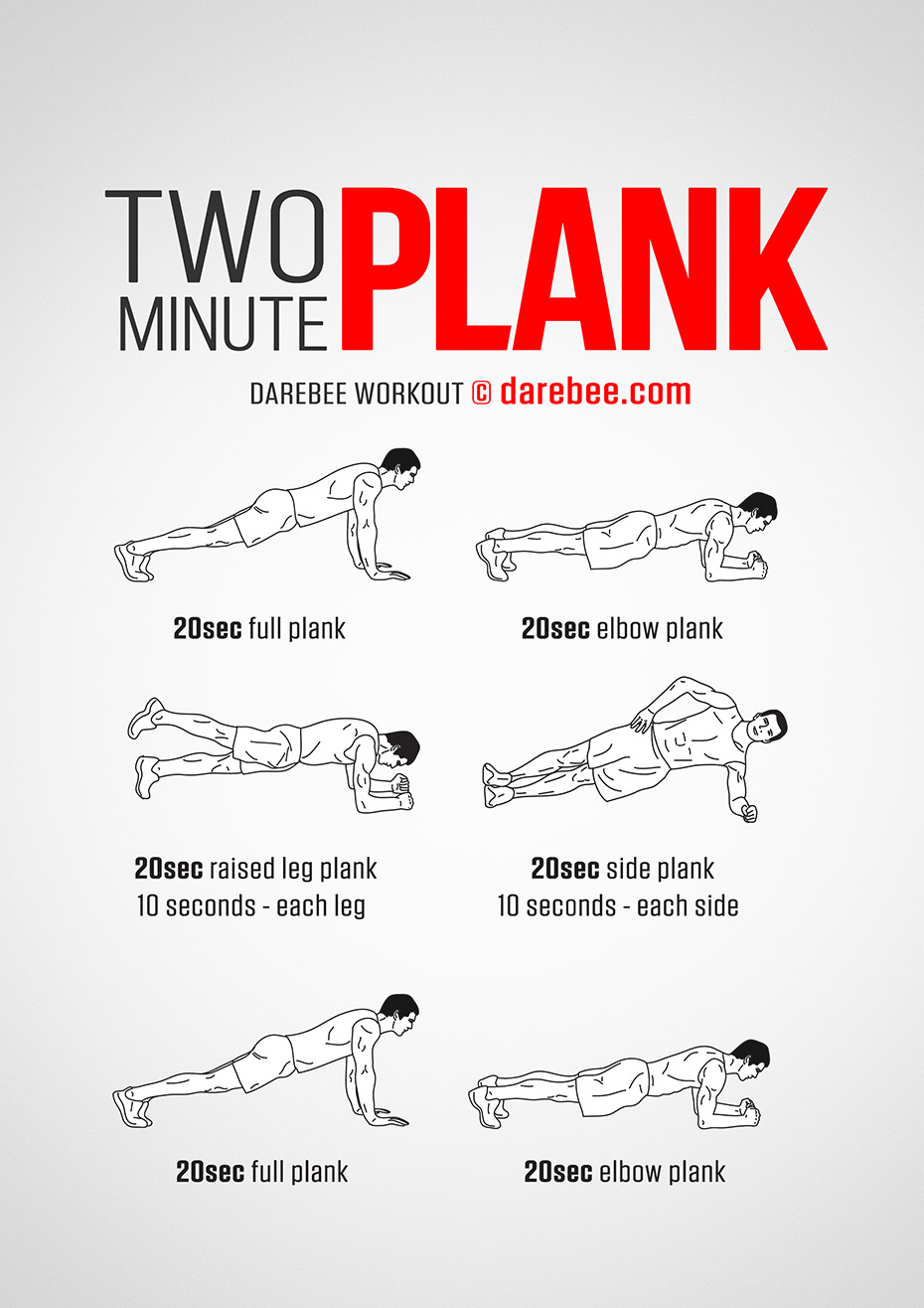




Two Minute Plank takes the structure of the one-minute version and doubles every hold: 20 seconds each of full plank, elbow plank, raised leg plank at 10 seconds per leg, side plank at 10 seconds per side, then full and elbow planks again to close. Same six positions, same order, twice the time under tension. It's the second rung of the plank series, and it's where a plank stops being a pose and starts being work.
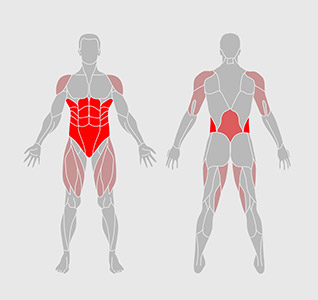
Twenty seconds per hold sits in an interesting zone. It's long enough for fatigue to genuinely arrive - somewhere around the fifteen-second mark of each hold, you'll feel your abs start negotiating - but short enough that the next transition always rescues you before form collapses. That's deliberate. By rotating the load between your anterior core, your deep stabilizers, your glutes and your obliques just as each group begins to tire, the sequence accumulates two full minutes of trunk work that would be much harder to survive as a single unbroken hold. Endurance builds fastest right at the edge of fatigue, and this workout keeps you camped there.
The cues that mattered at one minute matter double here. Keep your body in one straight line in the full and elbow planks - hips level, glutes engaged, neck neutral with your gaze at the floor. In the raised leg plank, the lifted leg should extend behind you at hip height, not swing up high, and your hips should stay square to the ground. In the side plank, drive your supporting forearm or hand into the floor and lift through your hips rather than hanging off your shoulder joint. If you feel your lower back taking over at any point, reset your pelvic tuck before continuing.
Two minutes, six positions, zero equipment. The difference between this and the one-minute version isn't complexity - it's commitment.
Make it Harder: Extend both side plank holds to 20 seconds per side.
Make it Easier: Take the raised leg and side planks from your knees and keep everything else as written.