
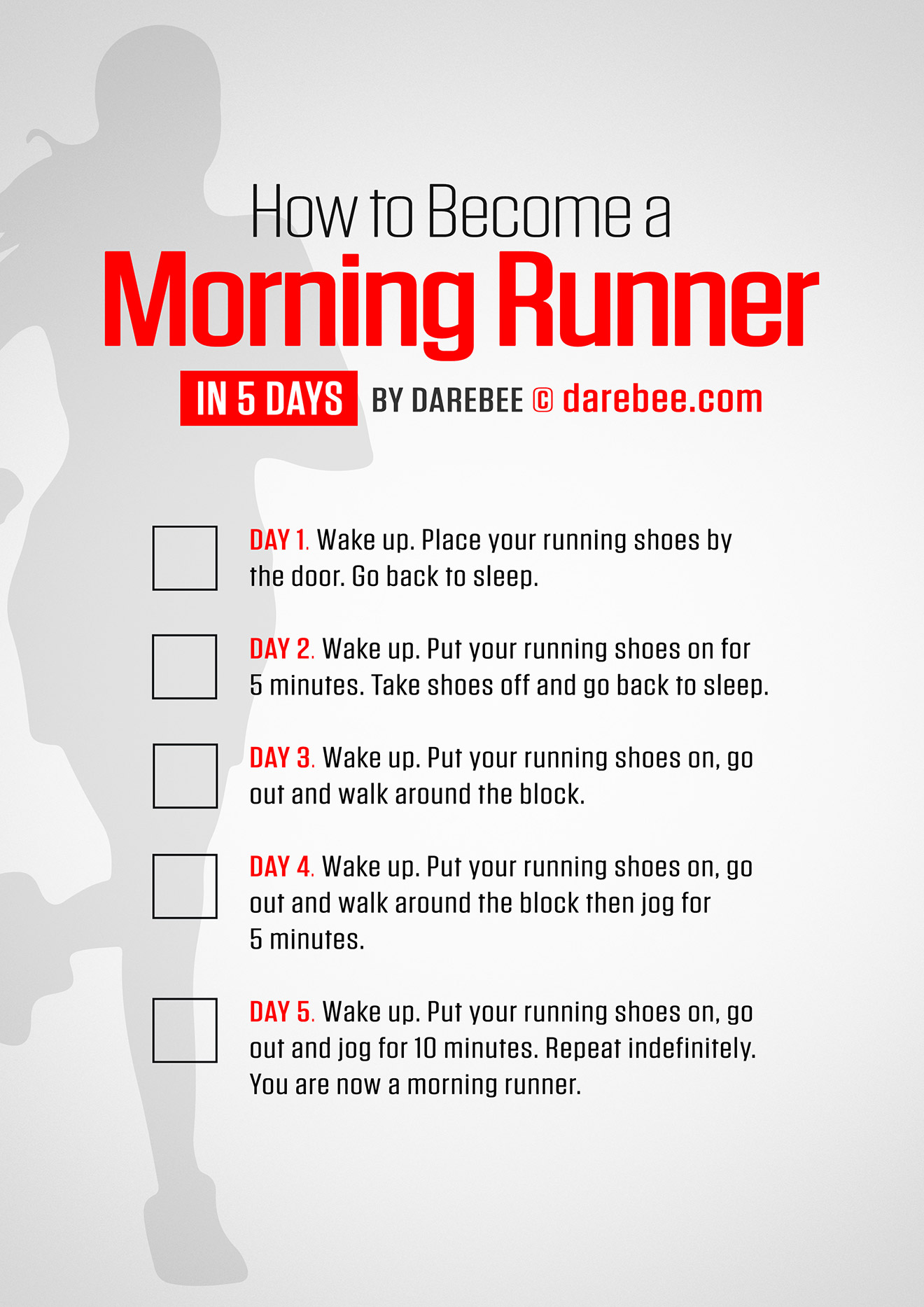
Morning running is won the night before. The alarm-clock battle that defeats most aspiring morning runners is not a willpower problem but a preparation problem: a 6 AM decision made by a groggy brain against a warm bed loses on merit. The method is to remove the decision - clothes laid out, route chosen, bedtime moved - until the morning contains nothing but execution. The case for bothering is practical rather than mystical. The morning slot is the one meetings do not invade, and consistency of timing is itself a training variable: among adults who successfully maintained their exercise habits long-term, those who trained at a consistent time of day accumulated more total weekly activity than time-switchers and the most common consistent slot they had settled on was early morning.[1] The slot works because nothing else wants it.
The Night-Before System
Everything the morning needs, staged the evening before:
- Clothes out, by the bed or in the bathroom - down to the socks so dressing requires no light and no thought. Winter layers included, per the cold weather guide.
- Route decided. The morning brain gets a plan, never a menu. A default loop you could run asleep is the right first route.
- Alarm across the room, phone with it - standing up is the whole battle, and the snooze button is the battle lost in installments.
- Bedtime moved back to fund the alarm. This is the non-negotiable center of the system. A morning habit paid for with sleep is a loan against the exact resource running is meant to build, and sleep restriction degrades endurance performance, mood and perceived effort across the athletic-sleep literature.[2] If the bedtime cannot move, the morning plan waits because the sleep guide outranks this one.
- Tomorrow's reason, named. One concrete line - the interval session, the podcast episode, the sunrise - gives the waking brain something specific to get up toward.
The Colder Machine
Body temperature sits at its daily low in the early morning, and performance rides temperature. Strength, power and speed all test lower in the morning than in the late-afternoon peak, with the time-of-day literature attributing much of the gap to the cooler body itself.[3]
The practical translations are straightforward. The morning warm-up runs longer, at five or more minutes of walking and easy jogging before anything brisk, which is double what the afternoon needs. The first kilometer is part of the warm-up on every morning run, whatever the plan says. Morning paces run slower at the same effort, which is temperature rather than lost fitness, and effort-based pacing absorbs it automatically. And hard sessions, meaning intervals and sprints, deserve the most generous warm-ups of the week when scheduled early. There is one more time-of-day fact working for you: adaptation is partly time-specific so bodies trained repeatedly at 6 AM get better at performing at 6 AM.[3] The morning stiffness of week one is not a permanent tax.
The First Three Weeks
Week one is the hard one, and it is easier run gently. Schedule only easy, short runs for the first two weeks because the project is moving the wake time rather than training hard at it, and stacking both difficulties is how morning plans die by Thursday. Two or three mornings a week beats five failed ones. The other runs stay in their old slots until the mornings feel owned. Light helps the clock along, since getting outside into daylight is itself the strongest signal shifting your body clock earlier so the run assists its own habit. By week three the wake-up stops being a negotiation for most people, and the slot begins doing what recruited it: existing reliably, before the day can object.
Who Mornings Are Wrong For
Some people are better off keeping their evenings. Genuine evening chronotypes - the minority whose body clocks run late by constitution rather than by phone habit - pay a higher price for early alarms and perform better later. Shift workers' clocks answer to the shift rather than the sunrise, and anyone whose sleep is currently short or broken has a prerequisite project. The test is honest: after three weeks of the full system, with bedtime moved and evenings protected, mornings that still feel like debt collection are information. Evening running is a complete answer, as the best time to exercise guide concludes when it finds that the kept slot beats the theoretically better one.
Common Mistakes
- Same bedtime, earlier alarm. This is the system's most common failure because sleep pays for the run until the runner quits or frays. Bedtime moves first.
- Deciding at 6 AM. The groggy brain versus the warm bed is not a fair fight. All decisions belong to the night before.
- Hard sessions in week one. Move the wake time or train hard, but not both at once. Easy runs carry the transition.
- Racing the morning stiffness. The colder machine wants its longer warm-up and its slower first kilometer, every day, indefinitely.
- Reading week one as the permanent experience. The adaptation - both the clock's and the time-specific performance kind - needs three weeks before the verdict.
- Forcing mornings against a genuine evening chronotype. Consistency at your workable hour beats misery at the theoretically ideal one.
What To Expect
Expect the first week to feel like a negotiation and the third to feel like a routine, since the transition is front-loaded and the wake-up softens noticeably once the clock shifts. Morning paces will run slower than evening paces at the same effort throughout because that is temperature rather than fitness, while morning performance itself improves across weeks as the time-specific adaptation arrives. The recruitment benefits show up fast. Sessions stop being cancelled by the day's events because they end before the events begin, and the banked-run feeling recolors the hours that follow. And the runs themselves acquire the morning's particular pleasures - empty routes, cool air, the day's first light - which is what converts most morning runners from system-followers into people who would not trade the slot back.
Win It The Night Before
Morning running is a preparation system rather than a test of willpower: clothes staged, route pre-decided, alarm across the room, bedtime moved to fund it all and easy runs carrying the first two weeks while the clock and the colder machine adapt. Run the system honestly for three weeks, with warm-ups doubled, pace by effort and sleep never taxed, and the slot nothing else wants becomes the most reliable training time you own. Or you learn cleanly that your hours live elsewhere, which the consistency evidence says is a winning answer too.
Summary
Morning running is won the night before: clothes out to the socks, route pre-decided, alarm across the room, one named reason for tomorrow and, the non-negotiable, bedtime moved back. A run funded by sleep loss borrows against the resource training builds, and sleep restriction degrades performance and mood across the athletic literature. The case for mornings is the slot itself, since consistent-time exercisers accumulate more total activity and early morning is the slot life least often steals. The machine runs cooler at dawn, where performance tests lower and much of the gap is temperature so double the warm-up, spend the first kilometer easing in, pace by effort and know that time-specific adaptation makes you measurably better at your hour within weeks. Transition on easy runs only, two or three mornings a week for the first two weeks, let daylight shift the clock and give the verdict three weeks, honoring the exception that genuine evening chronotypes keep their evenings with the evidence's full blessing.
Research
- 1. Schumacher LM, Thomas JG, Raynor HA, Rhodes RE, O'Leary KC, Wing RR, Bond DS. Relationship of consistency in timing of exercise performance and exercise levels among successful weight loss maintainers. Obesity (Silver Spring). 2019 Aug;27(8):1285-1291. doi: 10.1002/oby.22535.
- 2. Fullagar HH, Skorski S, Duffield R, Hammes D, Coutts AJ, Meyer T. Sleep and athletic performance: the effects of sleep loss on exercise performance, and physiological and cognitive responses to exercise. Sports Med. 2015 Feb;45(2):161-186. doi: 10.1007/s40279-014-0260-0.
- 3. Chtourou H, Souissi N. The effect of training at a specific time of day: a review. J Strength Cond Res. 2012 Jul;26(7):1984-2005. doi: 10.1519/JSC.0b013e31825770a7.