
Individual DAREBEE workouts are sorted by type and focus as well as difficulty. Use the filter at the top of the workouts’ page:
 Select workouts for “cardio” or “HIIT” to get workouts more suitable for weight loss, slimming down and toning up.
 Select “strength” option to get workouts more suitable for muscle building and muscle definition.
Most of DAREBEE routines are full-body workouts and already have ab exercises included but if you want to get additional midsection definition, use the filter and select workouts for “abs” and include them into your training as extra or in between workouts during the week.
All DAREBEE workouts are designed for all genders, regardless of illustrations. There is no difference in difficulty or approach in routines with different illustrations in them.
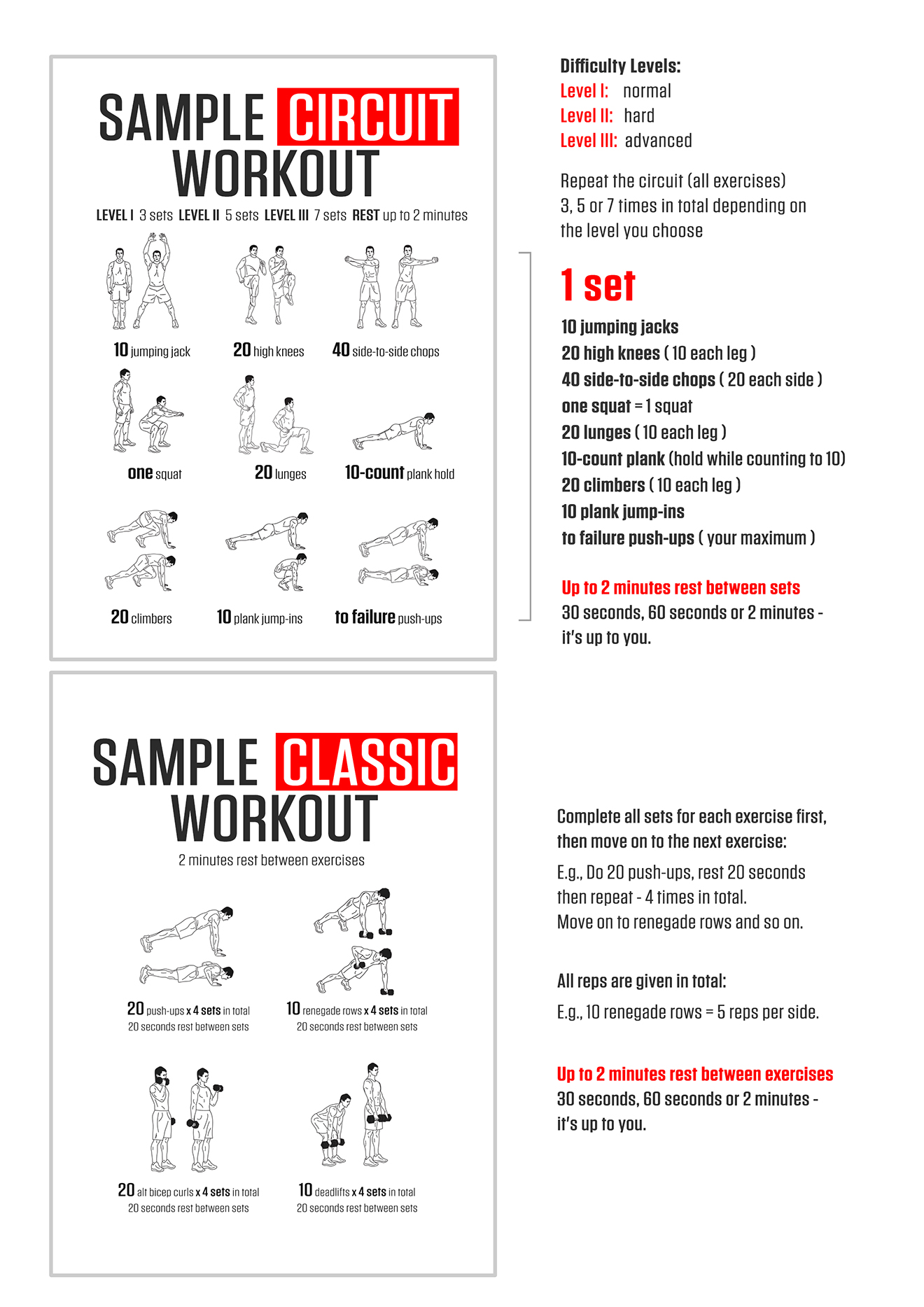
Workout posters are read from left to right and contain the following information: grid with exercises (images), number of reps (repetitions) next to each, number of sets and rest time. Images that show two positions of an exercise are dynamic moves e.g. jumping jacks and squats, you can find a how-to video for most of them in our video exercise library.
Exercises that only show a single images are static exercise e.g. planks and wall sits which you hold to a count (count to ten, for example) or for a given amount of time.
Circuit Vs Classic Workout Types
There are two primary types of DAREBEE workouts: circuit and classic. Circuit workouts have levels I, II and III with levels and sets located at the top of the poster. The entire poster is one single set. Complete all of the exercises and their corresponding reps before taking a break. You then rest and repeat until you've done all of the sets for the level you chose.
Circuit workouts' levels allow you to scale workouts up or down depending on how you feel on that day and how much time you have to work out:
Level I (3 sets) will take ~10 minutes
Level II (5 sets) will take ~15-20 minutes
Level III (7 sets) will take ~25-30 minutes
Classic workouts have sets and rest times listed under each exercise. You complete all sets for every exercise first and then move on to the next exercise in a classic setup.
Reps
"Reps" stands for repetitions, how many times an exercise is performed. Reps are usually located next to each exercise’s name. Number of reps is always a total number for both legs / arms / sides. It’s easier to count this way: e.g. if it says 20 climbers, it means that both legs are already counted in - it is 10 reps each leg.
Reps to failure or maximum means to muscle failure or your personal maximum, you repeat the move until you can't. It can be anything from one rep to twenty, normally applies to more challenging exercises. The goal is to do as many as you possibly can.
Reps throughout the day means that your goal is to get all of the numbers in by the end of the day. You can split the total number of reps for the day into manageable sets. In some of the challenges it is a necessity, in others an optional extra. Using this option will help you complete any challenge on your fitness level. Ideally, you want to do as fewer sets as possible. Most of the time you will begin to need this option a week or two into the challenge.
Combinations
Some workouts will contain combinations or "combos". Combinations will have two or three exercises with a "+" between them, for example "3combos: 10 high knees + 2 push-ups".
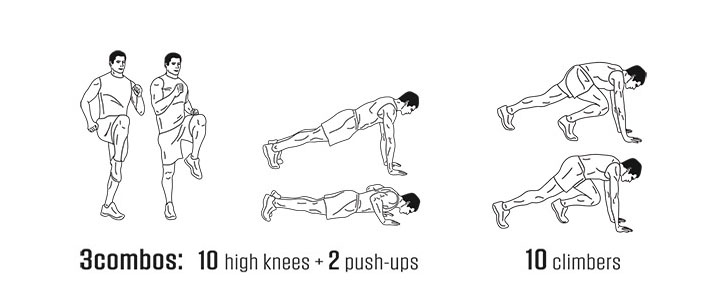
To complete the combo you will need to do 10 high knees followed up by 2 push-ups three times in total before you can move on to the next exercise.
Transitions between exercises
The transition from exercise to exercise is an important part of each circuit (set) - it is often what makes a particular workout more effective. Transitions are carefully worked out to hyperload specific muscle groups more for better results. For example if you see a plank followed by push-ups it means that you start performing push-ups right after you finished with the plank avoiding dropping your body on the floor in between.
Filter by Difficulty
To find workouts more suitable for your current fitness level use a filter at the top of each section for workouts, programs and challenges.
Difficulty Level 1 ( Light ): Standing exercises only, some seated exercises. Exercises include: various arm exercises, march steps, step jacks, side jacks, various leg raises. It's an ideal category for anyone who is severely overweight, is recovering from injury or has limited mobility. It is also a good category for active recovery days.
Difficulty Level 2 ( Easy ): Standing and floor exercises - but no planks. This category contains low impact exercises: reverse lunges, hops, squat holds, butt kicks and reverse lunges. This category will also be a good option for recovery days or for anyone with limited mobility and/or joints' issues.
Difficulty Level 3 ( Normal ): This category is the middle-ground for all of our routines. It's challenging and effective but it doesn't include any of the high impact exercises like push-ups, jump squats, jumping lunges, squat hops or burpees. You will see wall push-ups, though. This category includes: all types of jumping jacks, high knees, squats, most plank variation, pull-up bar hangs.
Difficulty Level 4 ( Hard ): High impact exercises: jumping lunges, jump squats, burpees, regular (and knee) push-ups, pull-ups, up & down planks, plank jacks and plank jump-ins. This is where it gets hard.
Difficulty Level 5 ( Advanced ): All workouts with complex exercises can be found at level 5. You will see workouts with the following exercises in here: single leg squats, single leg balance exercises, push-up variations, jump knee tucks and hook kicks.This category is calisthenics territory.
Rest Time
Circuit workouts: There is no rest between exercises in circuit workouts - only after sets. You have to complete the entire set going from one exercise to another as fast as you can before you can rest.
Classic workouts: In classic type of workouts the rest time is specified under each exercise.
What does "up to 2 minutes rest" mean: it means you can rest for up to 2 minutes but the sooner you can go again the better. Eventually your recovery time will improve naturally, you won't need all two minutes to recover - and that will also be an indication of your improving fitness.
Recommended rest time:
Level I: 2 minutes or less
Level II: 60 seconds or less
Level III: 30 seconds or less
Push-ups
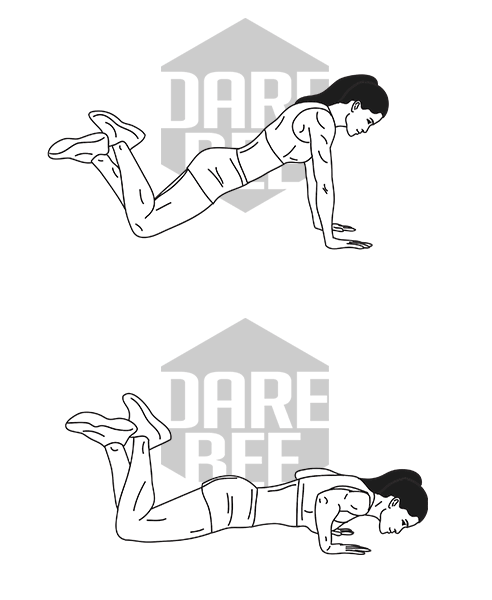 If you can't do all out push-ups yet on Level I it is perfectly acceptable to do knee push-ups instead. The modification works the same muscles as a full push-up but lowers the load significantly helping you build up on it first. It is also ok to switch to knee push-ups at any point if you can no longer do full push-ups in the following sets.