How to breathe correctly during exercise

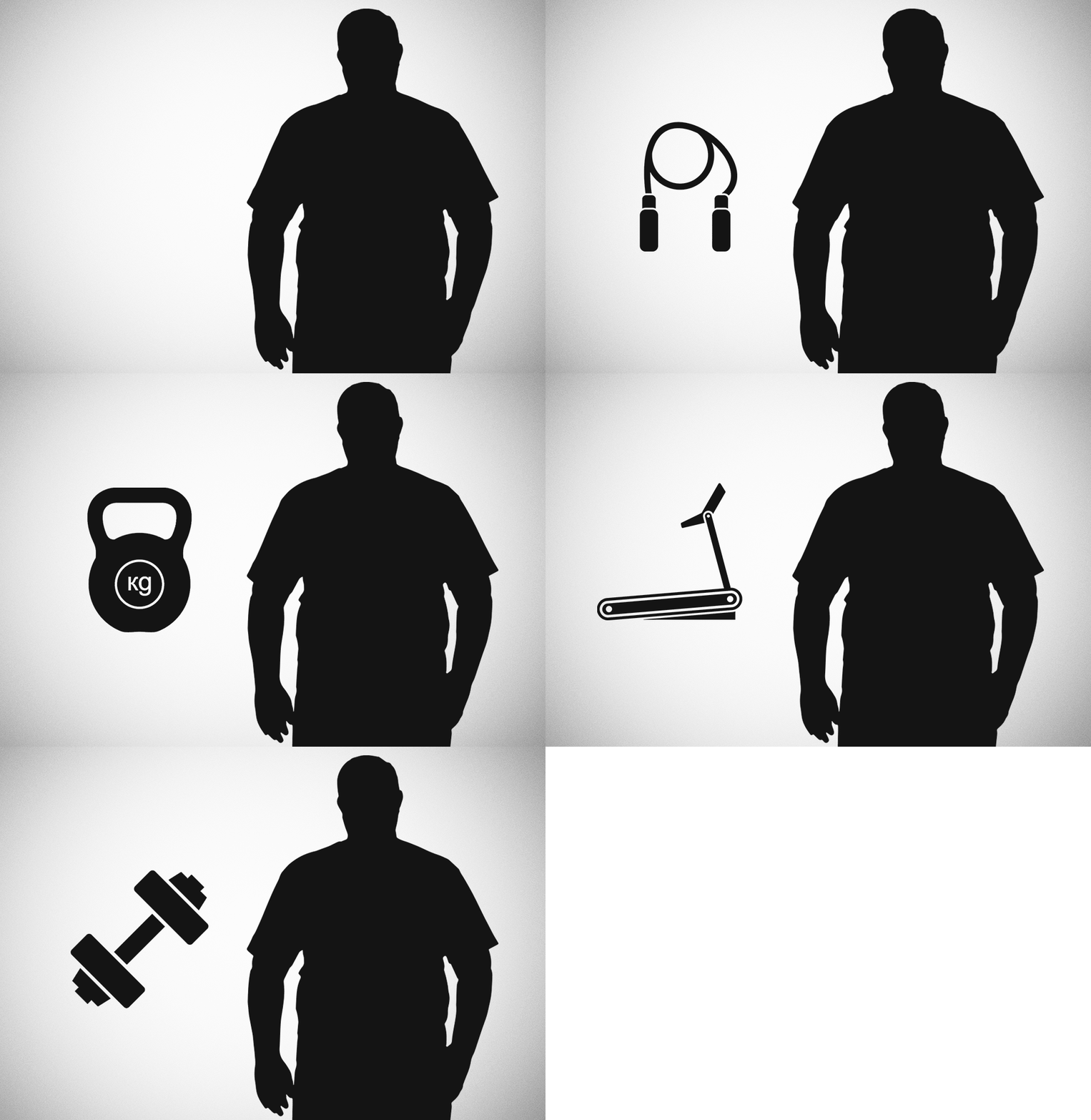
You can start training today, at the size you are now, at home, with no equipment, no gym and nobody watching - and it will work. Exercise is not something you have to earn access to by losing weight first: it delivers strength, energy, better sleep and better health at every size, starting from the first week. One promise up front: there is no moralizing anywhere in what follows, because none is deserved. You are here, which means you are starting.

Will This Actually Work For Me?

Yes, and better than it works for most people, which is the part nobody tells you. Every benefit curve in exercise science is steepest at its least-active end: the huge pooled analysis of 36,383 adults wearing activity trackers found health risk falling fastest across the very first steps out of a sedentary life, at any intensity.[1] In plain terms, the walk you take this week buys more measurable health than any single workout a marathoner will do this year. The gains available to you are the largest ones the research has found.

And here is the finding worth reading twice, especially on the days the scale is running your mood: fitness and weight are separate things, and fitness is the one with the bigger say. When researchers pooled the studies comparing fitness, body weight and mortality, people who were fit had similar risk across every BMI category, while people who were unfit carried roughly double the risk at every weight, thin people included.[2] You do not need to become a different-sized person for training to protect you. It starts protecting the person you are now, from the first weeks, whether or not the scale ever gets involved.

Is It Safe To Start At My Size?

Yes, managed the way any smart trainee manages their own starting point. There are two honest facts about a heavier body in training, one encouraging and one practical. The encouraging one is that you are stronger than you think. Your legs have been squatting, climbing and carrying more load than most gym-goers ever train with, every day, for years. When formal training starts cashing that in, strength tends to arrive fast.

The practical one is that impact and joint stress deserve respect rather than fear. So the early menu is joint-kind on purpose: walking, water work if you have access to a pool, which is near-zero joint load for a full training effect, cycling, and chair-supported exercises. Every jump in every DAREBEE workout also has a step-based quiet version that trains the same thing. You are not doing a lesser version of exercise. You are doing the correctly engineered version for your starting point, exactly as a good coach would insist.

If your knees are already a worry, one more piece of encouragement from the research: in adults with knee trouble, each kilogram of weight lost was measured to reduce the load on the knees by roughly four kilograms per step,[3] across thousands of steps a day. If any weight comes off later, your knees collect the payout at four times the rate. In the meantime, they get the joint-kind menu and gradual progress, which serves them at every weight. And this is the standard line every new trainee gets, at every size: if you are managing blood pressure, diabetes, or a heart or joint condition, a quick green light from your doctor comes first, not because you are fragile but because that is how everyone with a diagnosis starts.

Your First Month, Held By The Hand

Today, this is the whole workout: put on comfortable clothes, step outside or clear a bit of floor, and walk for ten to fifteen minutes at a pace where you could chat with someone. That was training. It counts in full, and tomorrow you do it again.

  • Weeks 1-2: walking is the program. A near-daily walk, growing by minutes rather than by miles or speed. The step research puts the steepest health gains exactly where you are standing: moving from 2,000-3,000 daily steps toward 5,000-6,000 buys more risk reduction than any equal jump anywhere higher on the curve.[4] If outside does not work for you - weather, neighborhood, knees, privacy - march in place, walk the hallway, follow any easy indoor session from the collections below. Indoors counts in full.
  • Weeks 2-3: add the strength foundations, two short sessions a week. Chair-assisted squats - stand up from a chair, sit back down, repeat - are the single most useful exercise you will ever do, because they are the movement independence is made of. Add wall push-ups, which are the correct entrance to push-ups for almost every beginner at every size, as the honest ladder logic describes, and rows with a resistance band or two filled water bottles. Eight to twelve of each, two or three rounds, done.
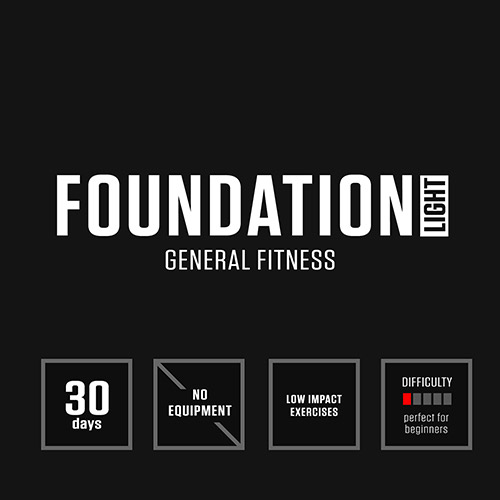
  • Weeks 4-6: extend gently. Longer walks, maybe a third strength day, and when you want the thinking done for you, the Foundation Light program is the ready-made version of exactly this ramp. One rule governs all growth: change one thing at a time, by about 10%, and let a week settle before growing again.
  • The whole time: pace by breath. If you can talk, the pace is right. You never need heart rate zones, pace charts or anyone else's numbers, because your breath is the gauge and it is calibrated to you automatically.

The Stuff Nobody Puts In The Brochure

These are the questions people actually have and rarely get to ask, answered plainly. Chafing is solved with fitted synthetic layers (never cotton against skin that rubs) and anti-chafe balm from any pharmacy - it is equipment rather than embarrassment. You will sweat a lot and breathe hard fast. A bigger body produces more heat and the early weeks tax an untrained engine, both are physics, both improve on a visible weekly schedule, and the sweat guide will tell you your shirt was never a report card. Getting down to the floor and back up can be the hardest exercise in the room, so the early plan simply does not require it: chair, wall and standing versions cover everything until the floor stops being a project, and the sit-to-stand guide is the training that makes it stop. Furniture and equipment ratings get checked once, without ceremony - a sturdy chair without wheels for chair work, weight ratings on any bike or machine - and walking plus bodyweight training bypasses all of it. And nobody is watching. That is not a pep-talk line; it is the design. Home training at DAREBEE exists precisely so that the gym's mirrors, machines and audience are optional forever.

The Part Where You Are Tired Of All Of It

If you arrived here fed up - with your body, with failed starts, with advice - that is worth addressing directly, because it changes what kind of plan survives. Fed up is real fuel, but it burns fast and it tends to buy punishing plans that collapse by week three. What lasts is almost insultingly modest: sessions small enough that you cannot talk yourself out of them, done at the same time daily so the debate never opens, counted as wins at any size. A ten-minute walk on a terrible day is not a lesser version of the plan. It is the plan, working. Missed days are data rather than verdicts, and the streak restarts at the next session with nothing owed and nothing to confess. When motivation itself is the problem, which it will be some weeks for everyone, the motivation guide exists for exactly those weeks. You do not have to feel like training. You only have to be someone who does small sessions anyway, and the feelings catch up on their own schedule.

Do I Have To Diet Too?

No, and keeping the two projects separate protects both. Training builds fitness, strength, energy and the health returns above, at every weight, whether or not you ever change how you eat. Weight loss, if and when you want it, is mostly an eating project with training in a supporting role. The weight loss guide lays out that honest division of labor, the hunger guide handles the food-noise side with the same no-moralizing rule, and the walking for fat loss guide is the natural bridge when you are ready, built on the same walks you are already taking.

Keeping them separate matters most at the plateaus. When the scale stalls, and it stalls for everyone, the training keeps visibly paying in stairs, sleep and energy, which is exactly the moment people who fused the two projects quit the one that was working. Yours will survive, because it was never tied to the scale.

Where To Go From Here

Bookmark by need: the Cardio for Overweight People collection below was built for this exact starting point, Foundation Light is the first program when you want structure, the listening guide teaches the difference between good discomfort and stop signals, the energy guide explains why you will soon have more of it, and the soreness guide decodes the first weeks' aches. Everything else can wait until you are four weeks in and wondering what is next, which is a good problem to have and closer than it feels today.

Common Mistakes

  • Waiting to be lighter, fitter or braver before starting. Every version of that sentence has the order backwards. Starting is what produces all three.
  • Starting at some program's week one instead of your week one. Most plans silently assume a body that has been training. The month above assumes the opposite, on purpose, with zero apology.
  • Punishing sessions as penance. Training is not an apology and your body is not in trouble. Kind and repeatable beats brutal and abandoned by a wide margin.
  • Judging week three by the scale. The fit-versus-unfit findings never checked the scale. Judge by stairs, sleep, energy and the walk that got longer.
  • Avoiding strength work until you are lighter. This is backwards: strength is what makes everything easier now, and it protects muscle if weight loss ever joins the project.
  • Reading one bad week as the old story repeating. It is one bad week. The plan restarts at ten minutes, same time tomorrow, nothing owed.

What To Expect

Honestly, the first two weeks are the hardest and the least rewarding for almost everyone who starts, which is exactly why the plan above keeps them tiny. Then it turns. The early wins arrive in function rather than photographs: somewhere around week three or four the stairs argue less, sleep deepens, and the walk that used to be the whole workout becomes the warm-up. Strength will likely surprise you first and most, because the load your legs have carried for years converts to trained strength quickly. Breathing at a given pace visibly eases across the first month as the engine upgrades. And at some point, usually around six weeks and usually without ceremony, you will notice the sentence in your head has changed from "I am trying to start exercising" to "I train", at whatever weight that week finds you, with the health returns already banked since week one.

Start Today, Kindly, And Keep The Wins

Start at the size you are, today, with a ten-minute conversational walk, and build the gentlest strong month in fitness: walking as the program, chair squats and wall push-ups as the foundations, one small change at a time, breath as the only gauge. The science is on your side here - the steepest gains belong to the least active, fitness protects at every BMI, and every practical obstacle has an engineering answer. No moralizing, no penance, no permission needed. You showed up, which was the hard part.

Summary

Training works at every size, starting immediately, and works best for those starting from least active: risk falls fastest across the first steps out of sedentary living in the 36,383-adult accelerometer analysis, and fitness protects independently of weight, since fit people showed similar mortality across BMI categories while unfit people carried roughly double at every weight. Safety is engineering rather than fear. The built-in load means strength arrives fast, impact gets managed with a joint-kind menu of walking, water, cycling, chair-supported work and quiet versions of every jump, each kilogram lost - if that ever becomes a goal - unloads the knees roughly fourfold per step, and medical green lights apply to everyone with a diagnosis, at every size. The first month runs on ten-minute conversational walks growing by minutes, which is the steepest section of the step curve, then chair squats, wall push-ups and bottle rows from week two, gentle extension into Foundation Light, and breath as the only pace gauge. The unspoken stuff gets straight answers: chafing balm, heat physics, no-floor-required programming, furniture ratings checked once, nobody watching by design. Fed-up energy gets converted into small un-quittable sessions with missed days counted as data, and dieting stays a separate, optional project so the training survives every scale plateau. Start today, because the wins are already yours to keep.

Suggested Collections

Overweight cardio intro
Easy cardio intro
Light cardio intro

Research

3 people liked this article

Darebee buzzes like a bee just like my wife of 1000 years, oh I love her like a cat! but I have to give darebee 1000 stars because even with my rattly joints I can move like a belly dancer in the… Darebee buzzes like a bee just like my wife of 1000 years, oh I love her like a cat! but I have to give darebee 1000 stars because even with my rattly joints I can move like a belly dancer in the 1920's Yahooo!

Joe, 99, from South North Carolina

Started this website when my basketball coach recommended it to me. I love it because it's easy to use and free. This website also definitely works because I have seen numerous improvements. Thank… Started this website when my basketball coach recommended it to me. I love it because it's easy to use and free. This website also definitely works because I have seen numerous improvements. Thank you DAREBEE!

Big Drew, 14, from USA

Excellent work you guys doing here. No words of thanks are enough to express what I feel for you. My journey in training began through you, and even now, whenever I stop and return, you are the… Excellent work you guys doing here. No words of thanks are enough to express what I feel for you. My journey in training began through you, and even now, whenever I stop and return, you are the first people who come to mind.

OB, 38, from Jordan